News   GLOBAL  |  Apr 02, 2020
 11K     0 
News   GLOBAL  |  Apr 01, 2020
 43K     0 
News   GLOBAL  |  Apr 01, 2020
 6.9K     0 
Steve Munro reports that there are rumours of issues in the underground section of Line 5 with tracks and signals, meaning that there will likely be slow zones during operation.

"Trains won't drop down the portal at Brentcliffe and fly to Mount Dennis."
The issue is not with the tracks and signals. They are fine (finally).

The issue is with the maintenance regime that the winning proponent wishes to follow once the line is in operation. And, unfortunately, they are able to get final say.

Did such issue happen at the opening of a brand new line? I don't recall Sheppard having those issues on day 1.
Sheppard had a bunch of issues on day 1. It's just that virtually none of them were operational, as the line had been running for 6 months prior to service.

Dan
 
Did such issue happen at the opening of a brand new line? I don't recall Sheppard having those issues on day 1.
Sheppard was way less complicated. Eglinton among other things has been a systems integration nightmare. Some of this is due to newer code requirements, but for instance maybe in hindsight it should have been built with a more conventional lineside signal system rather than CBTC.

Eglinton is pretty egregiously bad but not the only transit project with these kind of problems, for instance I think the Melbourne Metro Tunnel had problems with CBTC too and is still in a limited service soft launch (a 3tph shuttle in off peak times only, and no peak service to AFAIK not risk a service meltdown in the peaks) until February. So I would expect any new build heavy rail subway line in Toronto to have some sort of launch issues too.
 
I found it ironic that when I boarded Line 2 to head for my first ride on Finch, it took 16 minutes to go from Royal York to Kipling due to bunched trains crawling to the end of the line. And after riding the new LRT - when I went down to Line 1 at Finch West, my train was sitting in the station, and it was close to ten minutes before it moved, due to some delay up the line.
It's not like slow LRT's are the exception to slow service on the TTC.

- Paul
 
I think everyone needs to be reminded why Transit City was proposed: we ain’t got enough money to build half a line of subway and our city was built on urban sprawl.

No one would have chosen surface LRT had we got healthy transit funding/investment since the mid 90s….
I don't think Toronto can afford LRT, especially when it doesn't perform better than buses.
 
Did such issue happen at the opening of a brand new line? I don't recall Sheppard having those issues on day 1.
It wouldn't have to happen on the Eglinton line, either. There is nothing inherent in the choice of technology that caused this, it all comes down to the people in charge and their ability (or lack thereof) to execute the project correctly.

If all were equal, but the choice of technology was different, do we really think this quagmire wouldn't have occurred? This is a problem with the PPP, and trusting Metrolinx to execute any project more complicated than spilling a drink on the floor.
 
Last edited:
It wouldn't have to happen on the Eglinton line, either. There is nothing inherent in the choice of technology that caused this, it all comes down to the people in charge and their ability (or lack thereof) to execute the project correctly.

I basically agree with this.

If all were equal, but the choice of technology was different, do we really think this quagmire wouldn't have occurred?

I don't think the rolling stock and the choice of power being third rail or panto would make any material difference. But, there is no question that full grade separation does, on average, produce a better, faster service, more consistently, albeit, on average, at higher per km construction cost, maintenance cost, and lengthier construction time.

As has been discussed ad nauseum now, there is zero excuse for Finch being anywhere near as slow as it is, its not even close.

Taking this over to Eglinton, there is a case to be made for complete grade separation (when we were in design, not now); based on the scale of density now set to be approved on Eglinton.

But, there are also intermediate choices.

Keeping the line under/above road level until about Victoria Park; and subsequently not allowing any mid-block stops that don't intersect transit routes, along with proper transit priority (including going ahead of left-turning cars where applicable)...would also have offered greater potential.

Given the debacle over Finch, I'm not sure we see the Crosstown debut in February as currently forecast. There will be clear pressure to deliver a much better day one offering than Finch and I'm not sure they're positioned to do that today.

TBD

This is a problem with the PPP, and trusting Metrolinx to execute any project more complicated than spilling a drink on the floor.

This I 100% agree with!
 
Last edited:
If all were equal, but the choice of technology was different, do we really think this quagmire wouldn't have occurred? This is a problem with the PPP, and trusting Metrolinx to execute any project more complicated than spilling a drink on the floor.

Not meaning to yank ML out from under a bus of their own making - but - the first mention of signal priority for Eglinton in this thread was made in message # 162 posted on April 6, 2009. (reading the first few pages of this thread from that era is actually quite thought provoking - some things have sure changed, others have not).

Over the years where EAs and plans were done and redone, plenty of commentary about signal priority happened.

it's worth noting history - how in that planning and replanning, TTC and ML were at loggerheads, to the extent of spawning talk that ML would take over TTC altogether - a silly idea, but evidence that many were convinced that nothing less than a total takeover would uproot TTC and City policy. One has to assume that ML was more amenable to using the technology, and the City was the opposing authority. This is reflected in the original speed and trip timing projections.

It is ludicrous that TTC staffers are now portraying signal priority as something new and unfamiliar in North America. That ought to be dealt with as deliberate attempt to mislead TTC Commissioners and City Councillors. Or incompetence.

Either way, had this project not included a handover to TTC, and had ML had a freer rein to override City decisions, one has to think there would be lots more signal priority included. Perhaps the valid criticism of ML is that they played too nice.

- Paul
 
The subway nuts were never pushing for a subway because they though it would have fewer operational issues getting it running.
Better speed, unimpeded by traffic lights on an artery such as Eglinton knowing TTC MO with operating rail vehicles at grade - yeah, the nutjobs had no clue in retrospect
 
Not meaning to yank ML out from under a bus of their own making - but - the first mention of signal priority for Eglinton in this thread was made in message # 162 posted on April 6, 2009. (reading the first few pages of this thread from that era is actually quite thought provoking - some things have sure changed, others have not).

Over the years where EAs and plans were done and redone, plenty of commentary about signal priority happened.

it's worth noting history - how in that planning and replanning, TTC and ML were at loggerheads, to the extent of spawning talk that ML would take over TTC altogether - a silly idea, but evidence that many were convinced that nothing less than a total takeover would uproot TTC and City policy. One has to assume that ML was more amenable to using the technology, and the City was the opposing authority. This is reflected in the original speed and trip timing projections.

It is ludicrous that TTC staffers are now portraying signal priority as something new and unfamiliar in North America. That ought to be dealt with as deliberate attempt to mislead TTC Commissioners and City Councillors. Or incompetence.

Either way, had this project not included a handover to TTC, and had ML had a freer rein to override City decisions, one has to think there would be lots more signal priority included. Perhaps the valid criticism of ML is that they played too nice.

- Paul
Yes, yes, yes. And yet we still have people making the poorly informed and/or bad faith choice to cheerlead for the City council, transportation services, TTC board and/or TTC staff. For some it almost seems like it's just to stick it to Metrolinx. As if this is team sport. Metrolinx is far from exemplary and often reminds everyone they are incompetent. But that doesn't mean they're the ones predominantly responsible for why Line 5 and 6 have such low average speeds / long trip times. As much as I'd love it to be true that Metrolinx is solely to blame for this fiasco, the preponderance of evidence afaik points more towards the City and TTC. Whether it's more the City or more the TTC doesn't matter much to the public. Whether it's a 40/60 Metrolinx/Toronto split or a 10/90, I don't know and I don't think it matters, as long as we get some progress ASAP. End of Q1 2026 couldn't come sooner.
 
I found it ironic that when I boarded Line 2 to head for my first ride on Finch, it took 16 minutes to go from Royal York to Kipling due to bunched trains crawling to the end of the line. And after riding the new LRT - when I went down to Line 1 at Finch West, my train was sitting in the station, and it was close to ten minutes before it moved, due to some delay up the line.
It's not like slow LRT's are the exception to slow service on the TTC.

- Paul

Yeah, we’ve never seen slow zones in the subway, schedule bloat, lineups at terminals, operational problems, lines that never get built, etc. Such a transit paradise.
The point is these LRTs are slow without slow zones.

If the TTC did a better job of maintaining the tracks the subways would be faster on a regular basis.

But the LRTs will always remain slow.
 
Truly. This argument that this project would be a roaring success if only the authorities had listened to reason and wisely chosen to make it significantly more complex and expensive...
Line 5 IS complex and expensive! Unecessarily so. That's the big issue with it.

I would even wager that the Ontario line will be less complex than Line 5.
 
The point is these LRTs are slow without slow zones.

If the TTC did a better job of maintaining the tracks the subways would be faster on a regular basis.

But the LRTs will always remain slow.
LRTs will remain a little slower than subways, but trivially so. And the biggest drawback to their speed is stop spacing, which is what you want, unless you want to blow even more money running parallel shuttle buses for those who can't walk far distances.

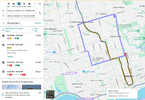
Finch - Vaughan: 38.39 km distance, travel time: 79 minutes, for an average speed of 29.16 km/h
Kennedy - Kipling: 26.23 km distance, travel time: 52.5 minutes, for an average speed of 29.98 km/h
Cedarvale - Bloor-Yonge: 11.47 km distance, travel time: 27 minutes, for an average speed of 25.49 km/h
1765589776063.png
Waterloo ion: 19 km end to end, travel time: 43 minutes, for an average speed of 26.51 km/h

Prague suburban lines:

Dědina - Dejvická: 7 km, 16 minute travel time = 26.25 km/h average speed
Výtoň - Libuš: 12 km, 28 minute travel time = 25.71 km/h average speed
Sídliště Barrandov - Slivenec: 2 km, 4 minute travel time = 30 km/h average speed
Sídliště Řepy - Anděl: 8 km, 18 minute travel time = 26.67 km/h average speed
Bílá Hora - Malostranská: 8 km, 20 minute travel time = 24 km/h average speed

LRT is a great way to unlock rapid transit and capacity for a far lower price than the subway. The fact that we don't do that falls squarely at the feet of the TTC, that's all. And "The point is these LRTs are slow without slow zones" isn't really an accurate statement, if the speed is kneecapped by the agency, it doesn't really matter what the maximum allowed track speed is, it's still a de facto slow zone. The LRT cars are capable of much superior performance compared to the atrocities the TTC is doing with them.

 
Last edited:

Back
Top

