News   GLOBAL  |  Apr 02, 2020
 11K     0 
News   GLOBAL  |  Apr 01, 2020
 43K     0 
News   GLOBAL  |  Apr 01, 2020
 6.8K     0 
That's great news. I don't imagine there'd be a purchaser so quickly if their plan was just to demolish the building. A hint at what might be coming for our Bay building might be gleaned from the article:

"The first was Astra Real Estate Corp., which signed an agreement on February 18 to buy the Hudson’s Bay Building at 200 8th Avenue SW in Calgary. Also known as Astra Group, the company is the parent of Peoplefirst Developments and behind several office-to-residential conversion projects in Calgary, as I’ve reported for Storeys..."
 
That's great news. I don't imagine there'd be a purchaser so quickly if their plan was just to demolish the building. A hint at what might be coming for our Bay building might be gleaned from the article:

"The first was Astra Real Estate Corp., which signed an agreement on February 18 to buy the Hudson’s Bay Building at 200 8th Avenue SW in Calgary. Also known as Astra Group, the company is the parent of Peoplefirst Developments and behind several office-to-residential conversion projects in Calgary, as I’ve reported for Storeys..."
So interesting the sale agreement was signed a month and a bit before that "what do we do with the Hubson's Bay Building?" session was held. Good to crowdsource some ideas I guess.

With Peoplefirst involved, I'm pretty optimistic they'll do good work here. Petrofina was very well done. I am very thankful, and I'm honestly excited to see what they can do. They've got some good practice with conversions and probably have some lessons learned they can apply here.

Also looks like it was a blind bid process so February 18th is the earliest they could've gotten an agreement.
 
Last edited:
It's kind of blurring the lines between what we typically talk about as a "development" project for a new building, but more on cultural and operational approach to policing.

Japan and a few other places have a neighbourhood policing model where there's a tiny (by our standards) policy station in the middle of the street staffed by a few local police officers. In busy areas it's a 24/7 operation. Info here: Koban police stations

The general idea is policing takes a far more serious approach to cultivating the relationship between the local community and the police presence that is permanently positioned there. Proximity and permanence is key - many tiny operations, focused mostly on acting as an information booth, first-responder to nearby issues, or an office to report crimes.

Example of a tiny police box in Tokyo area:

View attachment 732701

I think there's definitely merits in this kind of approach, but would be a really big sell culturally for an organization like CPS that's used to their district, car-based model of policing.

I don't know what Calgary's situation is, but imagine it's not much different that other big Canadian cities where the geographic relationship between the people doing the policing and the people being policed is drifting farther apart.

For example, an older but relevant article from Toronto found that greater than 75% of Toronto's police force didn't actually live in Toronto at all, let alone in the neighbourhoods that make the most sense for a community-based 24/7 presence.
https://www.theglobeandmail.com/can...hree-quarters-of-toronto-cops-reside-outside/

None of this is an insurmountable barrier to transitioning to a more community-centric, 24/7 present policing style, but there really is no evidence CPS has any interest in something like this, let alone any interest in even a conventional downtown station. It's also not clear any political or cultural movements would ever be able to force them to implement a more community-based style like seen in Japan.

This type of approach would make police more visible instead of a station which is just office work and by its nature only in 1 spot. The issue with Toronto is primarily housing costs. You'll find the same probably in Vancouver or other very high priced metros. I don't really think we need people to live in the East Village to work as an officer there. Most officers from the division is well aware of most of the people in the community. Policing in these communities really isn't about arresting people, because it won't change anything, but more about increasing the perception of public safety so that people feel safe living/going there.
 
This type of approach would make police more visible instead of a station which is just office work and by its nature only in 1 spot. The issue with Toronto is primarily housing costs. You'll find the same probably in Vancouver or other very high priced metros. I don't really think we need people to live in the East Village to work as an officer there. Most officers from the division is well aware of most of the people in the community. Policing in these communities really isn't about arresting people, because it won't change anything, but more about increasing the perception of public safety so that people feel safe living/going there.
Another thing about those police boxes, it gets cold here, it maybe isn't realistic for officers to always be on patrol. But having an officer and a window in a Sea can taking up a street parking spot or surface parking lot spot makes sense. Give homeless people airline-like blanket and pillow to give out (a physical symbol of who they have interacted with).
 

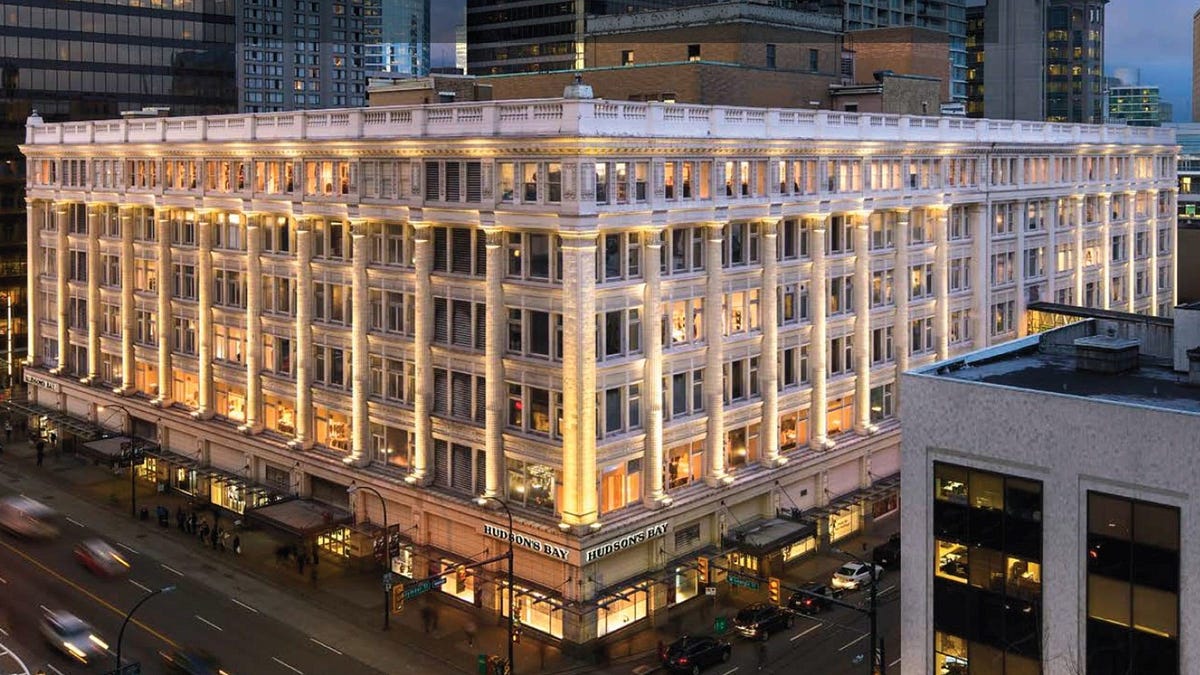
Astra Group buys Calgary's Hudson's Bay Building.

Glad it's not a developer like Truman but Astra seems to have some pretty craptastic conversions mixed with alright ones like Petrofina. Hopefully they are prevented from adding any vinyl siding / random square updates to the exterior. I presume there must be some form of heritage protection for the building?
 
The building is heritage listed, but not heritage designated. Designation would prevent demolition and require retaining historic elements. I think it's pretty likely that either a) it remains just listed, but any development maintains the façade as is, or b) it gets heritage designated, and therefore the façade is protected
 
Another thing about those police boxes, it gets cold here, it maybe isn't realistic for officers to always be on patrol. But having an officer and a window in a Sea can taking up a street parking spot or surface parking lot spot makes sense. Give homeless people airline-like blanket and pillow to give out (a physical symbol of who they have interacted with).
I think about it first as a relationship - change inner city police-style from "people who respond to your emergency calls but otherwise you never interact with" to "people in your community that are always around to help". Some of this occurs already, but it's a bit ad-hoc and situational - the missing link is a sustained, daily, highly visible relationship-based presence at all times of day.

That could take a number of forms in the inner city. I like the idea of a combo of a physical police mini-stations distributed far more regularly, but also a very different operational approach, where the job is to get to know your area and community. Almost a return to "walking the beat" - less focus emergency response, more about preventative relationship building, daily visibility, and most importantly, persistent presence.

Perhaps in the name of decades of centralization and efficiency-chasing we lost a bit of an important police/community connection by centralizing all police efforts to 8 to 10 stations over 800 square kilometres and 1.6 million people? Can't solve all our problems downtown, but would be curious if a "radical" approach to community policing would be effective.

Another observation from what's available from a quick google - if we had roughly the same brick-and-mortar ratio of police services as Tokyo, Calgary would have between 40 and 100 physical police facilities, not 8 to 10 stations. Doesn't matter if you use stations per population or per land area, either way Calgary would have dozens of more physical locations if we were to move to something closer to Tokyo.

Not saying it's good or bad - just highlighting cities do wildly different things with regards to brick-and-mortar choices for public services like police.
 
Another observation from what's available from a quick google - if we had roughly the same brick-and-mortar ratio of police services as Tokyo, Calgary would have between 40 and 100 physical police facilities, not 8 to 10 stations. Doesn't matter if you use stations per population or per land area, either way Calgary would have dozens of more physical locations if we were to move to something closer to Tokyo.

Not saying it's good or bad - just highlighting cities do wildly different things with regards to brick-and-mortar choices for public services like police.
A big part of that is probably the density of the city, it just takes much longer to drive the same distance in Tokyo than Calgary. Without having as many stations, they'd face significantly higher response times. While our stations are few and far between, most responses are done by units already in cars driving around, so the proximity to the actual station doesn't matter as much. I'm not sure about Tokyo, but in Taiwan, police often respond from the station, kind of like a fire station, and the local units are much smaller, like a storefront with police scooters parked out front.
 
One thing I'm hopeful about in terms of Peoplefirst acquiring The Bay building is almost every office to residential conversion has involved a financial contribution from the City of Calgary. My guess is that any future plans would depend on a similar contribution. This gives the City of Calgary an opportunity to attach certain conditions to that funding, much like what was done with the Event Centre. I would hope that the first condition would be preservation of the historic facade, even if it means a larger than normal contribution from the City of Calgary.
 
That's great news. I don't imagine there'd be a purchaser so quickly if their plan was just to demolish the building. A hint at what might be coming for our Bay building might be gleaned from the article:

"The first was Astra Real Estate Corp., which signed an agreement on February 18 to buy the Hudson’s Bay Building at 200 8th Avenue SW in Calgary. Also known as Astra Group, the company is the parent of Peoplefirst Developments and behind several office-to-residential conversion projects in Calgary, as I’ve reported for Storeys..."

Although I am happy that it is unlikely Astra/People First will demo the historic Hudson Bay building, their re-clads are some of the worst for office to residential IMO. I just hope to god that they do not touch the exterior facade beyond replacing the windows. All of these office conversion developers are in the market of making money, not providing an aesthetically pleasing building.


1777516897618.png
 

Back
Top