News   GLOBAL  |  Apr 02, 2020
 11K     0 
News   GLOBAL  |  Apr 01, 2020
 43K     0 
News   GLOBAL  |  Apr 01, 2020
 6.8K     0 
well it will all depend on the how exotic they want the final station designs to be. If theyre simple and more or less cookie cutter, we they can be built quite quickly with smaller chances of unforseen delays.
Now on the other hand if they decide to go fancy on their final designs, it might turn out like the YUS Ext.
 
I'm no expert, but I would presume that depth also avoid a lot of reworking/rerouting of water/sewer/power infrastructure that would be disrupted by cut-and-cover.

And as someone who works on Eglinton, I can't imagine what it would be like to deal with cut-and-cover along the length of the street. Disruption to travel and the local businesses has been bad enough with the various traffic rerouting -- if the whole street was torn up, I would imagine that many businesses would be wiped out.

But the disruption mid-block would be a matter of weeks to a month, and it would be one segment at a time. Not a continuous closure of the entire Eglinton. We have precast, prestressed concrete now which did not exist when the other lines were built in Toronto. It would also significantly reduce the construction at the intersections.
 
I suppose it would depend on just how much stuff is buried under the street - water mains, sewers, telecom, hydro, gas, etc. With tunneling, one only has to worry about those things where the stations are. With cut and cover, you'd be uncovering and potentially replacing all of it, end to end... and every building occupant would be impacted by sewer closures, water cutoff, etc. Coordinating all those services is a major undertaking, too.

I'm a bit dubious that it would only be a month's impact. Certainly it could be done, but I bet it would be more complicated and more costly than it sounds.

- Paul
 
The at grade sections will actually be completed before the tunneled ones. Thats how long tunneling takes compared to at grade construction. Go look at the ION LRT in kitchener that started work in 2015, and is further along than the tunnelled Eglinton section which started in 2010
tunnelling did not start in 2010, it started in 2013
 
And here's Laird Station: http://thecrosstown.ca/news-media/whats-new/laird-station-open-house

The one main difference you'll see is that Laird is mined unlike Keele and Eg West. Also we'll see Keele Station's structure complete in 2019 while they start Laird in 2019. Mined station wouldn't require the entire length of the station box to be dug up oppose to cut and cover.

Also, don't compare this with the ION. That's an LRT and this is an actually subway. The on-street LRT section doesn't start till 2018 and would end in 2021 (only 3 or so years).
 
Also, don't compare this with the ION. That's an LRT and this is an actually subway. The on-street LRT section doesn't start till 2018 and would end in 2021 (only 3 or so years).
@robmausser was comparing subway construction to surface construction. That was the whole point, to say that the surface construction for Eglinton will be faster than the subway construction for Eglinton. ION is an in-progress example of surface construction.
 
@robmausser was comparing subway construction to surface construction. That was the whole point, to say that the surface construction for Eglinton will be faster than the subway construction for Eglinton. ION is an in-progress example of surface construction.

Thanks for backing me up, some people on this forum are of such densities that I have a better time talking to a piece of hardwood.
 
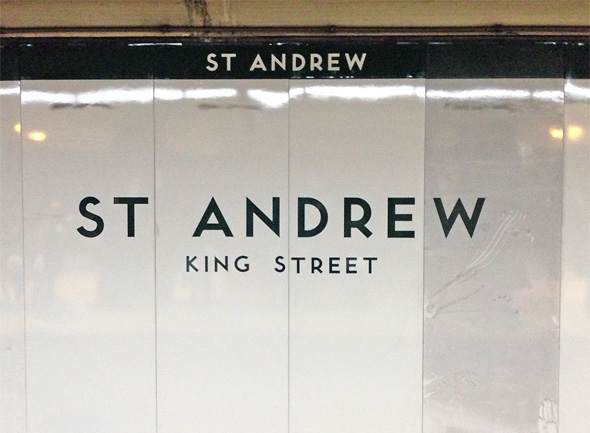
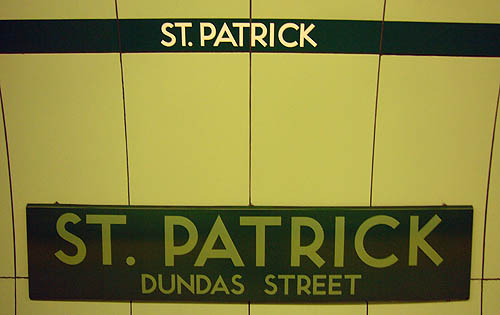
They should really put the cross street in brackets or something for these station names. When I look at the maps with the new names I don't know where they are. I feel bad for anyone trying to find Yonge Street on the new map. I hate to keep harping on it but it drives me crazy and makes me angry lol.
 
I know where St. Andrew and St. Patrick stations are NOW. When they first opened, it took a few trips to get my bearings. And the smaller font street names under the station names.

2013102-StAndrew-New.jpg


TTC_Sign_StPatrick_metalplate-500.jpg
 
I still don't know St. Patrick from St. Andrew. I know where Museum is there thanks to the museum. i don't think there is a St. Patrick or St. Andrew building or tower on top of the subway stop.

It may have been discussed elsewhere, but as a tourist in Tokyo, I loved that each transit line had a letter (I guess we are never planning on building more than 9, so numbers will do for us). Each station also had a number. It made it easy to navigate for a tourist, especially those who don't speak the language.
 
well it will all depend on the how exotic they want the final station designs to be. If theyre simple and more or less cookie cutter, we they can be built quite quickly with smaller chances of unforseen delays.
Now on the other hand if they decide to go fancy on their final designs, it might turn out like the YUS Ext.

Eglinton's timeline is determined by the hardest stations (neither subway interchange is cookie cutter or simple; with Yonge being the harder of the 2). Opening the line without those 2 stations isn't very helpful.
 
Eglinton's timeline is determined by the hardest stations (neither subway interchange is cookie cutter or simple; with Yonge being the harder of the 2). Opening the line without those 2 stations isn't very helpful.

That is why, as hard as it is to believe, they could still change plans and make the portion from Laird to Kennedy fully grade-separated - thus saving the cost of the SSE - and it would still be the interchange stations that are on the critical path

:) see, I didn't use the word elevated :)
 

Back
Top