News   GLOBAL  |  Apr 02, 2020
 11K     0 
News   GLOBAL  |  Apr 01, 2020
 43K     0 
News   GLOBAL  |  Apr 01, 2020
 6.8K     0 
Isn't the underground section of the LRT is literally a subway by definition?

sub·way
ˈsəbˌwā/
noun
  1. 1.
    NORTH AMERICAN
    an underground electric railroad.

Am I wrong assuming that the only reason it's considered an LRT is because it's mixed in with traffic when it's at street level. I can't see the only reason it not being considered a subway is due to it's width compared to our other rolling stock that are considered subways. The length certainly can't be the reason since it's almost identical to our Sheppard trains.
 
Last edited:
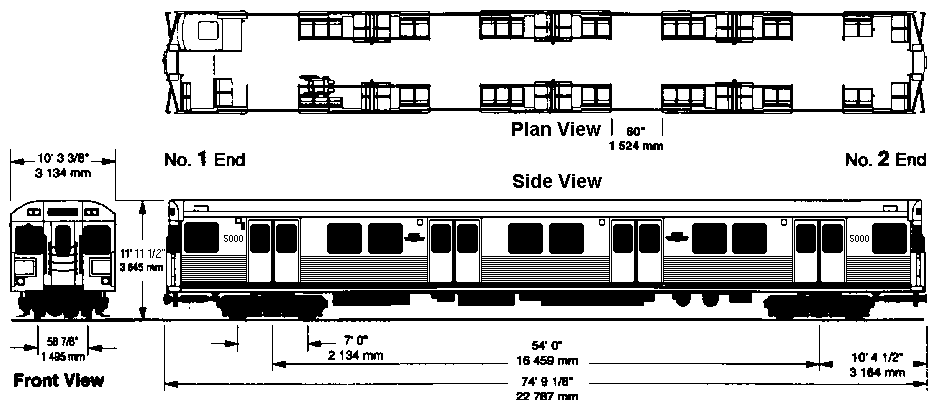
The London underground car is 2.602 m in width.
tube-surface-comp-reduced3.jpg


A Bombardier Freedom car is 2.65 m in width.

Therefore, ...

For comparison with a Toronto subway car:
subway-5505-03.gif
 
Given that and the realization that the freedom vehicles are actually less than half the length of our Sheppard trains - is the at grade section of the LRT the only reason this line is considered an LRT overall or is the length actually another reason?
 
Last edited:
Of course trains with open gangways and 2 cabs (no mid-train cabs) could be used.

This is the heart of why I was suggesting that the Flexity Freedom vehicles is a"light" solution for Crosstown. A 3-unit Flexity "train" will have six cabs, two between-car coupling gaps, and 12 bending diaphragm areas where the full width of the carbody can't be used for seating or standing. That's a lot of non-revenue floor area. Whereas a 4-car "Tube style" or "TR clone" train (no need to be more specific than that) with full width interior gangways would have only two cabs and three bending diaphragm areas - and hence more potential passenger capacity.

One would not have to change platform height or other specs to find such a car, I suspect. It doesn't sound like there will be many sharp curves where you would need a "slinky" style vehicle, although a four-car TR dimensioned carbody might be too long for this line's geometry.

So, if the Flexity isn't sufficient, a higher capacity vehicle could be found that meets the non-underground needs of this line. That makes me sleep better. What term you use to describe it is a futile debate.

- Paul
 
Eglinton tunnels are about ~15" larger diameter than TYSSE (256" TBM vs. 241" TBM) mostly because of requirements of the overhead catenary.

I don't remember the dimension, but the TYSSE tunnel is larger (8"?) than Sheppard because it has tight curves that need to be bigger to fit a 23 m long rectangular subway car through.
 
A set of six cars is 138m. A set of 8 like is currently used on Lines 1 and 2 are 184m long, so it's actually about half.

Sheppard line uses 4 car trains. 1 car is 23 metres. 23 metres * 4 = 92 metres.

The Eglinton crosstown can use 3 car trains. 1 car is 31 metres. 31 metres * 3 = 93 metres

They're the same length.
 
Given that and the realization that the freedom vehicles are actually less than half the length of our Sheppard trains - is the at grade section of the LRT the only reason this line is considered an LRT overall or is the length actually another reason?

If I recall correctly, light rail is supposed to refer to capacity, but the use of the term around the world is so inconsistent that there really isn't any point in debating it. We'll never find an exact catch-all definition.

Here in Toronto it's appears to be used because of the tram-style vehicles and the surface section.

And the length of the trains can be the same length as on the Sheppard Line, depending on the service configuration.
 
This is the heart of why I was suggesting that the Flexity Freedom vehicles is a"light" solution for Crosstown. A 3-unit Flexity "train" will have six cabs, two between-car coupling gaps, and 12 bending diaphragm areas where the full width of the carbody can't be used for seating or standing. That's a lot of non-revenue floor area. Whereas a 4-car "Tube style" or "TR clone" train (no need to be more specific than that) with full width interior gangways would have only two cabs and three bending diaphragm areas - and hence more potential passenger capacity.

Agreed. Different rolling stock, even with current dimensions, could have quite a bit of additional capacity.

It should be possible to mix & match trains provided the dimensions are the same. Flexity trains might run the full length of the line and a specialized (driverless, cabless, open-gangway) train could run the tunnel section at very high frequencies via ATC. The Flexity train would also run via ATC within the tunnel; I believe this is planned but it's hard to tell what details survived the hand-over to Metrolinx.
 
Sadly, pretty much the entire south side of Eglinton east of Yonge is slated to lose or become void of office space at this rate.

I don't like the sounds of that. I posted this infographic in another thread a couple weeks ago, but think it's worth presenting in a lot of contexts. Obviously there's a lot more to a centre's success than diversity of land use, but the variety of what exists is definitely important. I'd guess that office space is one of the hardest things to bring to a centre, and probably one of the worst to lose. If Y/E sees more loss of employment lands it might end up right at the bottom in terms of land use diversity.

GTHA-urban-growth-centres-land-use.jpg
 

Attachments

  • GTHA-urban-growth-centres-land-use.jpg
    GTHA-urban-growth-centres-land-use.jpg
    80.9 KB · Views: 940
Eglinton is really a sad case of the problem with employment land being converted to residential use in the city. There was a time people would actually try to live close to where they work, but now people tend to want to commute and enjoy long commute times to downtown Toronto. Then they complain that commute times are too long, when they are in a sense contributing to the problem.

Midtown Toronto would be an excellent secondary office "hub" but sadly that will likely never be the case again.
 
Eglinton is really a sad case of the problem with employment land being converted to residential use in the city. There was a time people would actually try to live close to where they work, but now people tend to want to commute and enjoy long commute times to downtown Toronto. Then they complain that commute times are too long, when they are in a sense contributing to the problem.

Is that really true though? It's not as if it's only new office space being built downtown. There's an enormous amount of residential as well. It seems that people want to both live and work downtown.
 
Nobody WANTS to commute. It's like the #1 thing people complain about on a regular basis.

The reality is that it's not that easy to live close to work. Offices concentrated where housing is expensive, or perhaps unsuitable for bigger families. One partner works downtown while the other partner works at the airport corporate centre, etc. Not to mention that people change jobs a lot more frequently than they used to, so it would mean moving more frequently, uprooting your family more often, etc.
 

Back
Top