



11th
Senior Member
Some how I think it can use less words and perhaps replaced with pictograms to a degree.
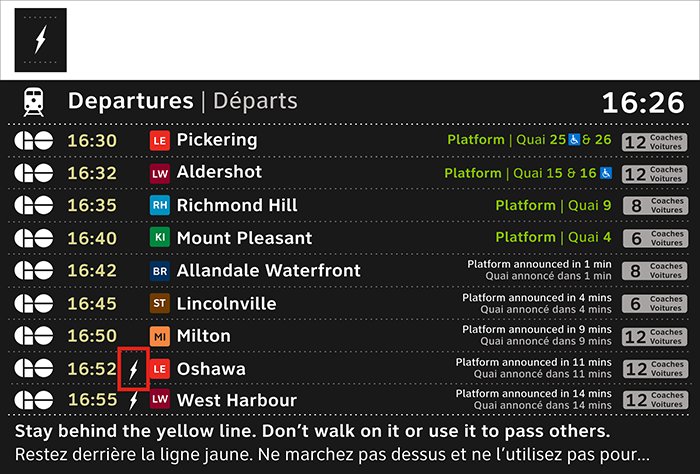
At least be consistent with formatting - platform vs. number of coaches.
|
|
|
Some how I think it can use less words and perhaps replaced with pictograms to a degree.

As for bus loop, unless ML picking up the full cost to move the new transit Hub to the station, its a dead issue for Stratford other than one bus bay.This might be a bit of a long shot, but following on from the train meets discussion a few pages back, would any consideration be given to relocating the Stratford railyard east of Romeo using powers and funding under the Railway Relocation and Crossing Act? Would allow creation of a multiple track station area, free up space for park and ride/bus loops, maybe some light TOD, perhaps some extra street grid connections.
Aside from other negative considerations, it might rip open the same demands in Hamilton, but it seems to me that it would strengthen the urban fabric of that part of Stratford (the TOD adding to the tax roll) and relocate the switching noise/inconvenience to the big box zone to the east away from the bulk of residential use.
View attachment 368959


Yes, GO expansion will offer more transportation option but for most, not a better one because in order for transit to be successful it must be accessible and in that metric, GO does extremely poorly. The reality is that GO is simply too expensive not only due to it's fares but also {and probably more so} due to having no fare integration. Accessibility is not just physical but also financial.
The whole point of this exercise is to offer more options at non-peak times. GO is successful as a commuter service because it is faster and cheaper than driving due to traffic and high parking rates. In off peak {and especially after 6PM and on weekends} those advantages disappear. Traffic is moving and parking is much cheaper or free.
The reality is that most patrons who use GO already have a car. This means that their car payments and insurance are basically going to have to be paid regardless of transit options. With todays better gas mileage and electric/hybrid vehicles, GO becomes the expensive option. Who in their right mind is going to take GO when they can get to their destination faster, more comfortably, and cheaper by driving? This is especially true if there is more than one person in the car which is far more common outside commuting hours which is exactly the new patrons GO is trying to entice. .
Spending money is the easy part and God knows Metrolinx excels at that but fare integration requires actual planning and political balls and Metrolinx has none. Metrolinx has done absolutely nothing about fare integration and much worse doesn't seem to think it's an issue. Recently the TTC & York Region have proposed very limited fare integration on key boundary routes which is suppose to be the job of Metrolinx............transit coordination across the entire GTAH. It's clear proof that Metrolinx has decided to simply abrogate this responsibility and the long suffering commuters of Toronto are paying the price.

I thought the February TTC report was just about TTC fare structures, particularly capping, and the fair fare policies. What indications are there that they've finally made progress on fare integration?As previously noted, an announcement is coming in the near future on some form of fare integration.
I don't have any details and can't speak to its quality, but I would expect to hear something before the end of Q1 2022 and maybe sooner (report on future fare structure options is going to the TTC meeting in February)
I thought the February TTC report was just about TTC fare structures, particularly capping, and the fair fare policies. What indications are there that they've finally made progress on fare integration?
Ah - good news maybe. I don't follow that thread very closely, I hadn't realised that fare integration was being discussed there.Read the actual letter, and maybe some of the observations in posts below.

Great news! Based on the chart you posted earlier, this was the lowest-hanging fruit along the line: a short 30 mph slow order in an otherwise 60 mph zone. Hopefully they are also working on the two other similar slow orders (one just east of Stratford and the other crossing Hwy 7 west of New Hamburg).So according to Trainssee and some people in the area, the speed restriction at Shakespeare between Stratford and Kitchener has been lifted and trains can now go 60 mph there. This saves 4-5 minutes. This could possibly put the total travel time at 3hr 43 mins. Still a long way off from the possible 2hr 40 minutes with the 1970s historical speed + Kitchener - Toronto improvements.

Almost every recent Metrolinx public meeting has had a question about fare structure in the region. They've consistently responded that an announcement will be coming likely in 2022.I thought the February TTC report was just about TTC fare structures, particularly capping, and the fair fare policies. What indications are there that they've finally made progress on fare integration?
Location of the 30 mph slow order which still exists west of New Hamburg (as of today):
View attachment 371560
I copy and pasted each individual line into excel and formated with one column with time and another with speed. I'll likely make another chart soon with the Guelph speed improvements.Great news! Based on the chart you posted earlier, this was the lowest-hanging fruit along the line: a short 30 mph slow order in an otherwise 60 mph zone. Hopefully they are also working on the two other similar slow orders (one just east of Stratford and the other crossing Hwy 7 west of New Hamburg).
Speed diagram previously posted by Krypto98
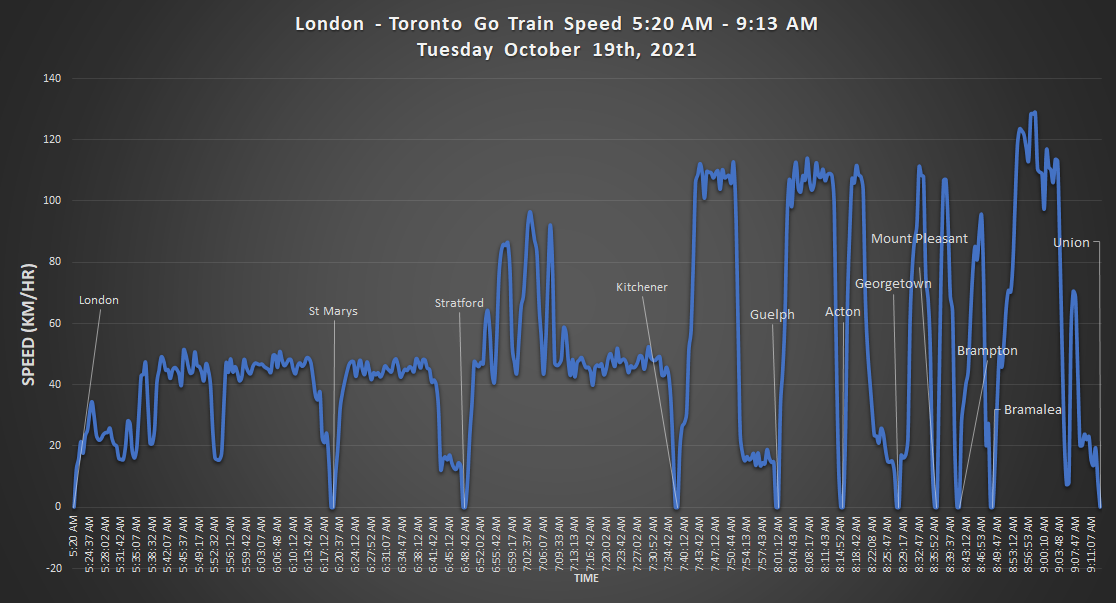
Location of the 30 mph slow order which still exists west of New Hamburg (as of today):
View attachment 371560
I highly doubt the time savings of resolving the single 30 mph slow order in Shakespeare would be 4-5 minutes, given that it was only a couple hundred metres long, and even a full station stop on a 60 mph line only adds about 2 minutes, including coming to a full stop and sitting still for 30 seconds.
And by the way, how do you make these charts? I looked quickly on transsee.ca but I didn't see any obvious way of exporting data.