News   GLOBAL  |  Apr 02, 2020
 11K     0 
News   GLOBAL  |  Apr 01, 2020
 43K     0 
News   GLOBAL  |  Apr 01, 2020
 6.8K     0 
light metro. Only Toronto thinks you need 15,000 PPHD to justify a metro line.

And BRT can handle higher volumes than you think - a well designed one can do 5,000PPHD or so. Demand routes higher than that need metro lines.

Ottawa can absolutely justify a subway and that's effectively what they built. Just because they made a bone-headed decision to use low floor LRVs for some reason doesn't mean that it's not functionally a light metro.

The fact that Toronto has so many routes running buses at their maximum capacity speaks to how undersized it's infrastructure is.

Toronto theoretically should be able to build an elevated light metro line for around $300 million going off of costs in Vancouver. Something like the Canada Line, which cost $121 million / km in 2009..
I agree with most of your post except the last bit where you suggest Toronto should build elevated metro.

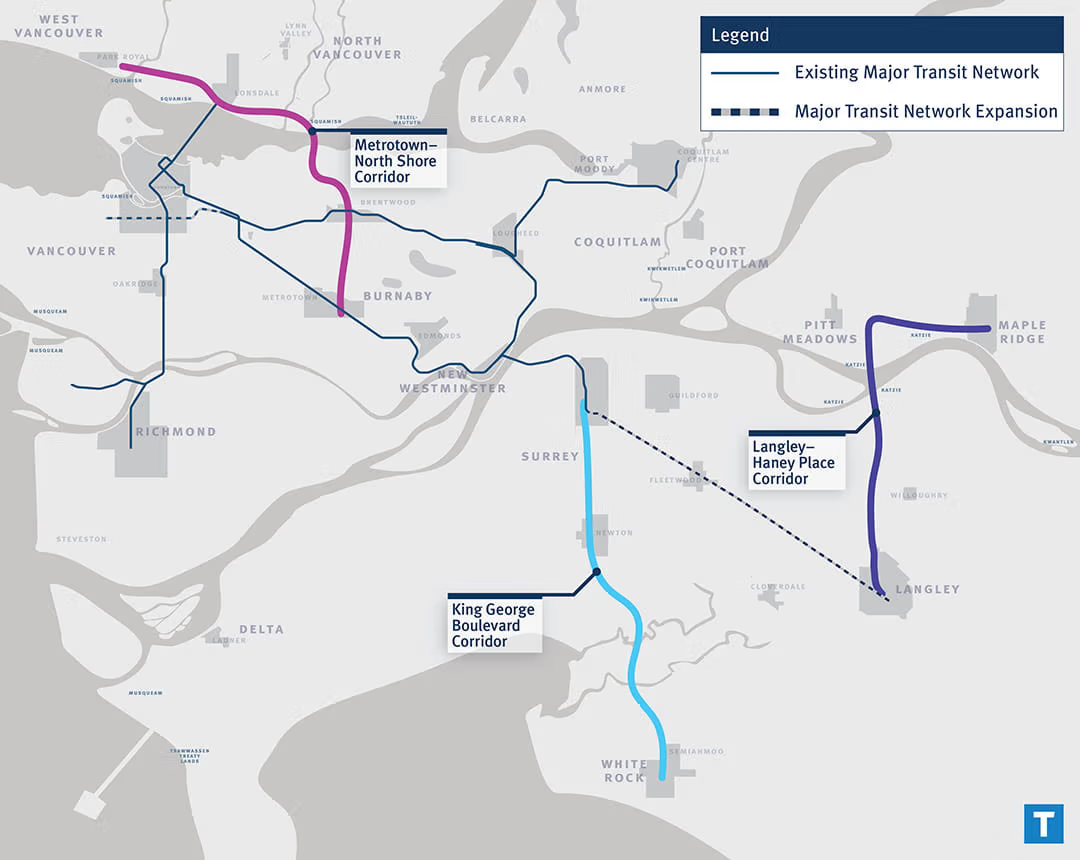
Downtown Toronto is too dense to build elevated metro. Even Vancouver is having a difficult time building elevated metro. Why did they opt to go underground with the Millennium Line extension? The Langley extension is elevated, but that's easy to do considering it's running parallel with a stroad, and the density along this route is much lower compared to downtown Vancouver.

I think going forward Vancouver is going to have to start burying a lot of it's SkyTrain extensions.
 
Translink only has 1 sky
I agree with most of your post except the last bit where you suggest Toronto should build elevated metro.

Downtown Toronto is too dense to build elevated metro. Even Vancouver is having a difficult time building elevated metro. Why did they opt to go underground with the Millennium Line extension? The Langley extension is elevated, but that's easy to do considering it's running parallel with a stroad, and the density along this route is much lower compared to downtown Vancouver.

I think going forward Vancouver is going to have to start burying a lot of it's SkyTrain extensions.
Translink only has one sky train expansion plan for the next 15 years after the current constructions are completed and that's to extend the Millennium Line to UBC, all other transit upgrades are BRTs

Priority BRT Corridors​

ct_regional_base_map_2.avif
 
Last edited:
Cheaper compared to what? A subway? I'm a very pro-subway guy, and I've never advocated for a subway along Finch. Not dense enough.

I've advocated for a BRT along Finch West. If the motivation was to build whatever is the cheapest, then they should have gone with a BRT.

People will make the "capacity" argument. But I think if you give buses their own lane, then having frequent, articulated buses would have helped to deal with capacity issues.

Things to remember.
  • In general parlance for Toronto, "subway" means grade-separated and not underground. Otherwise only Sheppard would count as a subway.
  • Also, "subway" does not have to be 150m trains. Once Ontario Line opens, it will be called a subway. Even 40m trains would be referred to subway as long at they were grade-separated and fast.
  • Also, not all subways have to run the exact same technology. It is ok to have 40m trains, 100m trains, and 150m trains on different lines depending on the need.
I didn't put much thought into Finch 15 years ago. I thought the best strategy was to do as little as possible (nothing or just some bus jump lanes at intersections) and use the money elsewhere to do what's needed there. My first thought was elevated "subway" (~40m trains) in the Finch hydro corridor. From Weston Road to Senaca College (eventually). It was only 300 to 400m north of Finch. I didn't quite think through how to get to Humber College.
 
Guess what, I'm not French and I figured out how to open the doors within seconds just by watching the Parisiens. Not a single instructional sign saying how to open the door.
I guess I must be a 200 IQ genius...That or Torontonians are truly (seen as) stupid.

View attachment 704512View attachment 704518
I firmly believe there is a segment of the population (5% or less) who will always manage to slide under the bar. If you lower the bar, they will somehow manage to go under it. As the saying goes, ""If you make something idiot-proof, someone will just make a better idiot". This results in the very same people both
1. Not able to figure out you have to press the button to open the door
2. Manage to figure out to press the button to open the door after the streetcar has already closed its doors
 
Cheaper compared to what? A subway? I'm a very pro-subway guy, and I've never advocated for a subway along Finch. Not dense enough.

I've advocated for a BRT along Finch West. If the motivation was to build whatever is the cheapest, then they should have gone with a BRT.

People will make the "capacity" argument. But I think if you give buses their own lane, then having frequent, articulated buses would have helped to deal with capacity issues.
Sorry for the ambiguity, by "nominally cheaper" I meant cheaper than building an LRT on Dufferin, Wilson/York Mills or Lawrence for example. It was cheaper to build on Finch West instead, but what we got was negative ROI at this point in time. It would've been better to put that money on projects that have higher proportional ROI, including low-cost bus lanes throughout the city in 2016, not 9 years after Line 6 started construction.
 
Last edited:
Translink only has one sky train expansion plan for the next 15 years after the current constructions are completed and that's to extend the Millennium Line to UBC, all other transit upgrades are BRTs
The premise of your argument is flawed. Vancouver's metro system is already very adequate for a city of its size, at roughly 1/3rd that of Toronto but with 80 km and soon 100 km of metro. The only place lacking metro-tier rail transit is the Millennium line to UBC and an extension/new line along the south of Vancouver/Burnaby southeast from UBC. Roughly circled in blue along with the 20 km of Skytrain extensions already under construction. This is congruent with page 10/12 of Vancouver's Transport 2050 strategy: https://www.translink.ca/-/media/tr...port-2050/transport_2050_summary_document.pdf
1766522354947.png
1766522424907.png

1766522881131.png
Metro Vancouver has 3.1 million over 2,900 sqkm, Toronto proper is 3.3 million over 630 sqkm.
 
Last edited:
Just wanted to share my experience from riding Line 6 east at 17:45 on Saturday December 20. I rode the full eastbound service and the service was significantly improved versus opening day.

I observed the driver operating the vehicle more comfortably than before, with the vehicle reaching the full speed limit of 50-60 between intersections. Additionally, the driver slowed to just 30-35 at intersections and sped up after the front of the vehicle passed the halfway point of the intersection (technically violating the 25 km/h policy). The vehicle operated ahead of schedule for most of the route and observations show the schedule is extremely padded off-peak.

I recorded the stop arrival and departure times versus the scheduled times as well as light dwells and schedule padding holds.

Stop NameArriveDepartScheduledLight dwellSchedule dwell
Humber College
17:45​
17:45​
Westmore
17:48​
17:48​
17:48​
Martin Grove
17:49​
17:49​
17:52​
Albion
17:52​
17:52​
17:55​
0:02​
Stevenson
17:52​
17:53​
17:56​
Mount Olive
17:55​
17:59​
17:58​
0:01​
0:04​
Rowntree Mills
18:01​
18:02​
18:03​
Pearldale
18:03​
18:03​
18:05​
Duncanwoods
18:04​
18:05​
18:07​
Milvan Rumike
18:07​
18:07​
18:09​
0:02​
Emery
18:10​
18:10​
18:12​
0:01​
Signet Arrow
18:12​
18:13​
18:14​
0:02​
Norfinch Oakdale
18:15​
18:15​
18:18​
Jane and Finch
18:18​
18:18​
18:22​
0:02​
Driftwood
18:19​
18:19​
18:23​
Tobermory
18:20​
18:21​
18:25​
Sentinel
18:23​
18:23​
18:28​
0:01​
Finch West
18:26​
18:31​
Total runtime
0:41​
Total light dwell
0:11​
Total schedule dwell
0:04​
Actual runtime
0:26​

Total end-to-end running time was about 40 mins 30 seconds, even with a 4 min hold from transit control at Mount Olive station and 11 mins worth of red lights.

This trip has improved my confidence in the performance of Line 6 and I think the design is actually fine. You could shave about 11 mins and 1 min off the running time if the city is able to revise the signal programming to permit aggressive TSP and from raised speed limits respectively, plus the 4 mins of schedule dwell giving a possible off-peak running time of 25 mins. I'd say during peak periods you could add 5 mins to that for heavier customer loading and traffic patterns.

This would raise the average speed of Line 6 to 25 km/h during off-peak and 21km/h during peak, which is respectable for light rail. More importantly, it would improve the speed of the LRT to be faster than the bus during almost all periods (except for late evenings).

Unfortunately some aspects of the speed cannot be improved such as during the curves between Humber College and Westmore, between Albion and Mount Olive, and between Sentinel and Finch West. The Alstom Citadis Spirit vehicles seem to not be able to handle curves of any sort and make terrible noises even when going at reduced speeds around them. Ironically, the Flexity Outlooks seem to handle curves in the track with much better comfort and performance.

Thanks for the update. Relying to bring this up because I had to go back through pages to find it.
 
There are too many pro-tram / pro-LRT idealists here that overlook the unfortunate realities of North American urbanism at hand. We can't just pretend car-centrism and its consequences accumulated for over half a century has no effect on transit usage patterns and transit mode suitability. I know it's not malice, but system justification ignorance. I would LOVE for Toronto to have walkable tram lined streets. The REALITY is that just isn't going to happen anytime soon. Maybe not even by 2100. Simply pigeon-holing a tram onto a stroad is not going to magically turn it into a utopian European paradise.

If anyone has set foot in Frankfurt am Main, Rhine-Ruhr, and Stuttgart, they'd know that their non-tunnelled Stadtbahn areas are not at all like Jane & Finch, even if the densities are ostensibly similar if we look at a small circle around Jane & Finch. Urban morphology aka street layouts, street widths, building heights, and zoning* play a much greater role than just nominal density figures.

*euclidean vs. mixed-use
Yea I worked in Eschborn Frankfurt, which led me to get rid of the perception that all of Europe is a singular medium density, super walkable, tram-lined entity, since I got more exposure to the outer parts & suburbs of the city that tourists usually don't touch.

I remember in my first day moving into my flat in Harheim, realizing that, hey, this is the same suburbia I'm used to at home (just with some more fourplexes and a closer grocery store). And in my second day, going to Niederrad to play football soccer, and realizing that, hey, this isn't a complete departure from North American urbanism.

In these outer areas, the Stadtbahn is able to cooperate in the middle of arterial/key roads (in Praunheim for instance, or along the northern part of Eschersheim Landstrasse, the city's main N-S axis, where they did pigeon-hole the at-grade section, because the city was too broke to afford tunneling here); it is used in areas with similar density to Jane & Finch where there are some larger apartment buildings in a sea of single-family residential (Preungesheim); and it is used in areas where there is really not much density at all, that is comparable to the bottom quartile of neighbourhoods by density in Toronto (e.g. Nieder-Eschbach, Bonames, the southern part of Bad Homburg; or the town of Oberrusel, which has ~45K people, yet has 10 stops over a ~5.1km stretch of U3 - this takes 15 minutes ==> so multiply this by 2 and add higher dwell times and that gets you to that Metrolinx number of 33-34 minutes)

So once signalling speeds up the line, then I imagine it will do the things necessary to get many of the people who live along the line to the places they need to be in a satisifactory way. My understanding, based on the demographics/data (and reputation & rumours people know them by...), is that for many in these neighbourhoods - they kind of live in their "own city" that is a bit detached from the Toronto we think of (and definitely downtown - with the exception of some UofT students and perhaps some people who work in the PATH)
 
Last edited:
Yea I worked in Eschborn Frankfurt, which led me to get rid of the perception that all of Europe is a singular medium density, super walkable, tram-lined entity, since I got more exposure to the outer parts & suburbs of the city that tourists don't touch.

I remember in my first day moving into my flat in Harheim, realizing that, hey, this is the same suburbia I'm used to at home (just with some more fourplexes and a closer grocery store). And in my second day, going to Niederrad to play football soccer, and realizing that, hey, this isn't a complete departure from North American urbanism.

In these areas, the Stadtbahn is able to cooperate with arterial roads (in Praunheim for instance, or along the northern part of Eschersheim Landstrasse, the city's main N-S axis, where they did pigeon-hole the at-grade section, because the city was too broke to afford tunneling here); it is used in areas with similar density to Jane & Finch where there are some larger apartment buildings in a sea of single-family residential (Preungesheim); and it is used in areas where there isn't much density at all (e.g. Nieder-Eschbach, Bonames, the southern part of Bad Homburg; or the town of Oberrusel, which has ~45K people, yet has 10 stops over a ~5.1km line on their section of U3 - this takes 15 minutes)

So once signalling speeds up the line, then I imagine it will do the things necessary to get the people who live along the line to the places they need to be. My understanding, based on the demographics/data (and reputation), is that for many in these neighbourhoods - they kind of live in their "own city" that is a bit detached from Toronto (and definitely downtown - with the exception of some UofT students and perhaps some people who work in the PATH)
Good anecdote. Yes Europe is not some tram-lined walkable utopia everywhere you go.

IMO, another pertinent issue none of us have mentioned with Line 6* (and trams in Toronto) is the distance of the average commute in part caused by zoning. Not that many people are living and working along 10 km of Finch et al in Northwest North York and Northern Etobicoke. The difference between Toronto and a typical midsized European city is perhaps not as big as some people think, but Toronto is still a megacity, easily top 5 if it were in Western Europe. Toronto is much denser and bigger than Frankfurt am Main: https://en.wikipedia.org/wiki/Frankfurt_Rhein-Main_Regional_Authority

It's a multitude of factors that make metro the more optimal form of transit for Toronto as opposed to trams. Another factor is that density is concentrated along corridors and nodes to a greater degree and to a greater magnitude than in European tram or stadtbahn cities (but at the same time, commutes can be relatively long).

"The majority of people now work in a usual location, travelling an average of 22.8 km one-way in a straight-line distance. Thanks to modern vehicles that travel 50 km/hour or more, the average commute now takes 26.2 minutes." https://www150.statcan.gc.ca/n1/daily-quotidien/171129/dq171129c-eng.htm

"The average one-way commuting distance remained unchanged at 17.2 kilometres compared to the year before." https://www.bbsr.bund.de/BBSR/EN/home/topnews/commuters-2023.html

*being built prior to transit improvements elsewhere
 
Last edited:
Good anecdote. Yes Europe is not some tram-lined walkable utopia everywhere you go.

IMO, the other pertinent issue none of us have mentioned with Line 6* (and trams in Toronto) is the distance of the average commute in part caused by zoning. Not that many people are living and working along 10 km of Finch et al in Northwest North York and Northern Etobicoke. The difference between Toronto and a typical midsized European city is perhaps not as big as some people think, but Toronto is still a megacity, easily top 5 if it were in Western Europe. Toronto is much denser and bigger than Frankfurt am Main: https://en.wikipedia.org/wiki/Frankfurt_Rhein-Main_Regional_Authority

It's a multitude of factors that make metro the more optimal form of transit for Toronto as opposed to trams. Another factor is that density is concentrated along corridors and nodes to a greater degree and to a greater magnitude than in European tram or stadtbahn cities (but at the same time, commutes can be relatively long).

"The majority of people now work in a usual location, travelling an average of 22.8 km one-way in a straight-line distance. Thanks to modern vehicles that travel 50 km/hour or more, the average commute now takes 26.2 minutes." https://www150.statcan.gc.ca/n1/daily-quotidien/171129/dq171129c-eng.htm

"The average one-way commuting distance remained unchanged at 17.2 kilometres compared to the year before." https://www.bbsr.bund.de/BBSR/EN/home/topnews/commuters-2023.html

*being built prior to transit improvements elsewhere
Toronto's borders overlayed onto Frankfurt via MapFrappe, i.e. two distinct cities (and capitals of their respective states), Wiesbaden & Mainz, as well as numerous mid-sized towns, fit into the same space as Frankfurt within these equivalent borders (in a different permutation, I can fit Hanau, Darmstadt and Offenbach centred around Frankfurt, so it's not like I'm rigging the output)

Here, it is the S-Bahn (in its semifunctional state), rather than the metro, that lets people GO places..... and links the region together.

And as was mentioned from a previous comment a couple days ago, the future state of Line 6 being able to connect UPX & GO at Woodbine, a future Bolton GO line, and Line 1 is exciting.

1766532692803.png
 
Last edited:
Toronto's borders overlayed onto Frankfurt via MapFrappe, i.e. two distinct cities (and capitals of their respective states), Wiesbaden & Mainz, as well as numerous mid-sized towns, fit into the same space as Frankfurt within these equivalent borders (in a different permutation, I can fit Hanau, Darmstadt and Offenbach centred around Frankfurt, so it's not like I'm rigging the output)

Here, it is the S-Bahn (in its semifunctional state), rather than the metro, that lets people GO places..... and links the region together.

And as was mentioned from a previous comment a couple days ago, the future state of Line 6 being able to connect UPX & GO at Woodbine, a future Bolton GO line, and Line 1 is exciting.

View attachment 704821
Frankfurt Rhine-Main or Rhine-Main Metropolitan Region is ~14,700 sqkm with just under 6 million people. GTHA is 8,200 sqkm with 8.3 million. GTA is 7,100 sqkm with 7.7 million.

Regionalverband Frankfurt Rhein-Main is 2,458 sqkm with 2.5 million people. Toronto proper is 630 sqkm with 3.3 million people.

By bigger, I meant comparing similar metropolitan areas, Toronto has the bigger population. As in common parlance, London is a bigger city than Toronto, not necessarily geographically bigger, but bigger in population. Toronto is also denser than Frankfurt Rhine-Main. So in both metrics that matter, Toronto is by far the bigger city.
 
Last edited:
Frankfurt Rhine-Main or Rhine-Main Metropolitan Region is ~14,700 sqkm with just under 6 million people. GTHA is 8,200 sqkm with 8.3 million. GTA is 7,100 sqkm with 7.7 million.

Regionalverband Frankfurt Rhein-Main is 2,458 sqkm with 2.5 million people. Toronto proper is 630 sqkm with 3.3 million people.

By bigger, I meant comparing similar metropolitan areas, Toronto has the bigger population. As in common parlance, London is a bigger city than Toronto, not necessarily geographically bigger, but bigger in population. Toronto is also denser than Frankfurt Rhine-Main. So in both metrics that matter, Toronto is by far the bigger city.
Buddy I think you might be arguing with yourself lol.

All I did was overlay that 630 sqkm border of Toronto across the Frankfurt area to show how large of an area that represents - and why regional & S-Bahn trains, rather than the U-Bahn, are the primary components that connects people living across that wide space; and thus why I am excited about Line 6 connecting a couple of these lines together one day. Nothing else from me!

+++

I presume that when planners were thinking about the Line 1 expansion in the 80s/90s, they never considered the option of it wrapping onto Finch West as it wasn't worthwhile vs. the corridor loop or the eventual result?
 
Last edited:
OK, fair enough. But in that case, why does it materially matter how far outside the core the corridor actually is? It's not as though density is a function of how far removed from the core the area is, there are a lot of factors.
It does matter... with context. If Toronto were a denser, more populated, and geographically larger city than Paris, then in that case it would more plausibly have a dense area like Finch West, much farther away from any CBD, downtown or otherwise. Generally speaking: it also matters because with the way North American cities are, especially skyscraper heavy Toronto, the downtown density skews the overall density higher; even though the density significantly drops off outside downtown unlike say, Paris. That is to say, somewhere 15-20 km from downtown in a city like Toronto might be less dense than somewhere equivalently isolated from Paris' inner city, if that somewhere is not a secondary CBD like Mississauga City Centre, North York etc...

The reality is, Toronto is not a denser, more populated, physically larger city than Paris, and it just so happens that Finch West is not as dense as the T9 corridor even though they once shared almost identical bus ridership figures pre-covid. But I will admit, once you get to Finch West's distance, it doesn't matter as much how far or near it is to downtown. The original point being that I think Line 6 is not in a dense enough area to warrant a tram. It being far from downtown is only one factor of many for its modal upgrade unsuitability.
Buddy I think you might be arguing with yourself lol.

All I did was overlay that 630 sqkm border of Toronto across the Frankfurt area to show how large of an area that represents - and why regional & S-Bahn trains, rather than the U-Bahn, are the primary components that connects people living across that wide space; and thus why I am excited about Line 6 connecting a couple of these lines together one day. Nothing else from me!
Yeah I wasn't entirely sure what you meant, but I wanted to make it clear in general that Toronto is a different animal. Didn't mean to make it sound adversarial.
 
Last edited:
OK, fair enough. But in that case, why does it materially matter how far outside the core the corridor actually is? It's not as though density is a function of how far removed from the core the area is, there are a lot of factors.

I read what you said very well. But despite the disclaimers you put, the entire rest of your argument is about how he got it more right than all the "experts". Your disclaimer goes against the entire rest of the content of your post, and it is very easy to see where your sympathies lie.


Because operational practices can change!!!

What part of this concept is so difficult for you to understand? All the pro-LRT folks are equally dismayed at the poor early performance of the Finch LRT, and want it to do better. You, and all the other subway foamers on this forum, seem incapable of comprehending, despite thousands of messages explaining to the contrary in great detail, that slowness is NOT an inherent feature of LRTs, and that the solution to that slowness isn't to give sprawling suburbia subways, but to improve the operational speeds.

You keep arguing against a strawman that doesn't exist. I repeat: slowness is NOT an inherent feature of LRTs. Suggesting it is is intellectually on the same level as saying that subways are bad because the H6 subway cars were unreliable lemons, or that buses are bad because the same could be said of the Orion hybrids. Maybe we wouldn't have to keep trotting out the same "inane points" over and over again if you actually mounted a coherent argument against them.

N.B. I am pro-LRT because it's a cheaper option of delivering high capacity transit. In a world that has limited amounts of money, the greedy suburbanites of Toronto should not have access to all the monies for new transit projects. If that strikes you as idolatry, that's your problem and should deal with it accordingly.
Back in reality, it runs at 11 kilometers an hour.
 

Back
Top