News   GLOBAL  |  Apr 02, 2020
 11K     0 
News   GLOBAL  |  Apr 01, 2020
 43K     0 
News   GLOBAL  |  Apr 01, 2020
 6.8K     0 
What this debates gets wrong is this. Finch west needed an upgrade. So many times a bus would be full and people would need to wait for multiple buses to pass before getting on one. It's true other corridors probably needed to be looked at first but the solution is not do nothing on Finch. The solution is invest in transit. Toronto's population is approaching 3 million. It should have more subways, but also more LRT's, more elevated rail , more bus lanes, and better regional rail integrated with the TTC. The city could introduce congested pricing to raise revenue, provide aggressive transit priority for surface routes, push Ontario government to fund GO train 15 minute sevice at least for toronto proper, and encourage development along transit routes to get the highest ridership possible. It's not rocket science, it just about politicians making the right choices.

No one here is arguing against transit investments along Finch or across Toronto. Were debating over which mode of transit could have best served this corridor.
 
A nitpick, Toronto's population is at least 3.3 million as of July 1, 2024, and probably more like 3.5 million due to growth and undercounts of NPRs e.g. visa renewals.
Toronto has likely lost around 100,000 people in population in the last 12 months. The whole out-of-control TFW program pumped numbers up artificially high and it's correcting now.

Finch should have seen a "simple" 6-lane widening with curbside bus lanes and more bus service, IMO, and taken the $1.8 billion in savings and done the same for various suburban corridors across the city.
 
Toronto has likely lost around 100,000 people in population in the last 12 months. The whole out-of-control TFW program pumped numbers up artificially high and it's correcting now.

Finch should have seen a "simple" 6-lane widening with curbside bus lanes and more bus service, IMO, and taken the $1.8 billion in savings and done the same for various suburban corridors across the city.
If you're going to put bus lanes on a 6 lane stroad you may as well just go full Highway 7 and build a proper BRT down the middle of the road, with actual stops. At least then not only could you sell it as an actual upgrade to local residents but it will also be easier to convert to LRT when it inevitably reaches capacity.
 
If you're going to put bus lanes on a 6 lane stroad you may as well just go full Highway 7 and build a proper BRT down the middle of the road, with actual stops. At least then not only could you sell it as an upgrade to local residents but it will also be easier to convert to LRT when it inevitably reaches capacity.
That costs roughly double per mile and actually results in slower operations than curbside operations as you now have to deal with protected left turn movements for vehicles.

You could do curbside lanes with an actual curb protecting the bus lane mid-block if you want, opening to allow right-turning cars to use the lane at intersections, but as soon as you need to separate bus operations from general traffic it actually gets slower since you need to introduce unique signal phases.

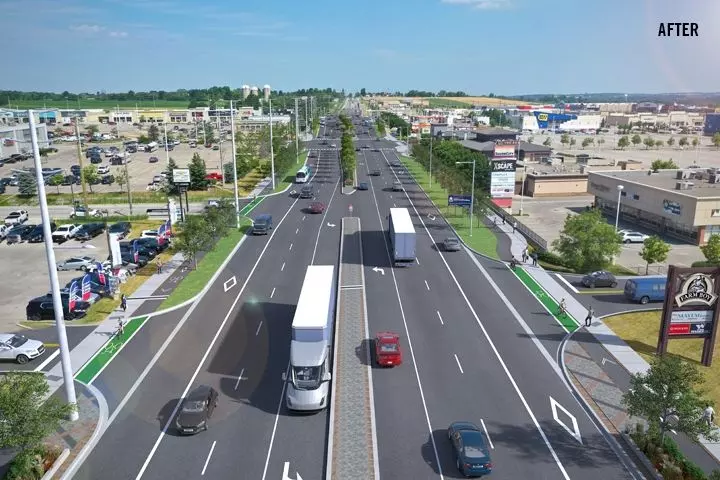
This costs half of much and has better operations and is safer for transit users than a median lane:

1766515777120.png


Full depth reconstruction with upgraded landscaping treatments for a 6-lane road costs about $50 million per kilometre. York Region is building this configuration in Newmarket right now. You could easily splurge a small bit extra to introduce higher quality bus stops with heated shelters if you wanted. The project has a budget of $94 million for 2 kilometres of reconstruction.


4_Town%20Line_Proposed-sm-after.webp
 
Last edited:
Toronto has likely lost around 100,000 people in population in the last 12 months. The whole out-of-control TFW program pumped numbers up artificially high and it's correcting now.

Finch should have seen a "simple" 6-lane widening with curbside bus lanes and more bus service, IMO, and taken the $1.8 billion in savings and done the same for various suburban corridors across the city.
I wonder if people are aware of just how much transit ridership numbers across Ontario municipalities have been inflated by TFW and International students?

Multiple cites across the GTA already reporting downward trends.
 
That costs roughly double per mile and actually results in slower operations than curbside operations as you now have to deal with protected left turn movements for vehicles.

You could do curbside lanes with an actual curb protecting the bus lane mid-block if you want, opening to allow right-turning cars to use the lane at intersections, but as soon as you need to separate bus operations from general traffic it actually gets slower since you need to introduce unique signal phases.
What? TPS exists for LRTs but not BRTs?
 
Toronto has likely lost around 100,000 people in population in the last 12 months. The whole out-of-control TFW program pumped numbers up artificially high and it's correcting now.

Finch should have seen a "simple" 6-lane widening with curbside bus lanes and more bus service, IMO, and taken the $1.8 billion in savings and done the same for various suburban corridors across the city.
36 bus ridership has not recovered to 2019 levels due to more online courses and less international student growth at Humber College. Also I don't buy the mainstream, pro-corporation narrative that already downplayed record breaking population growth in 2021-2022 by parroting PR issuances of ~400k (e.g. Globe and Mail) before it became no longer possible to hide non-PR population growth in 2023. The same media is also incentivized to downplay population growth now. They're there to protect oligopoly industries that benefit from cheap labour and a captive consumer market heightened by high population growth e.g. grocery stores, fast-food, and telecoms. There are many people among government, industry and academia that don't buy the narrative that Canada saw real population decline.

“We [have] more people in the country than you think. People say we are 41 million. No, we are 42 million in the country. But we are not counting one million,” Tal said.
https://www.mpamag.com/ca/mortgage-industry/industry-trends/we-are-in-a-recession-cibcs-tal/553608

"Tal and Lotin worry about repeating past planning errors based on lack of data. They warn such misjudgments could further strain housing supply and infrastructure, as well as fuel the underground economy and threaten national security.
StatCan estimates the country’s temporary resident population at about three million, or 7.1 per cent of Canada’s residents, says Lotin.

But Lotin and Tal believe it’s naïve for StatCan to assume, as it does, that all temporary residents leave the country within four months (120 days) of their study or work visas expiring, or their asylum-seeker status being rejected.

[...]

Many are concerned. Bank of Canada Gov. Tiff Macklem is among those who have raised doubts about Ottawa’s population projections. And Benjamin Tal, chief economist at CIBC Capital Markets, says Ottawa is underestimating population growth by at least three times.
[...]
If the statistical agency were more real-life, they say it would realize population growth could reach 1.1 per cent in 2025 and one per cent in 2026 — more than three times the government’s official forecasts.
'If we add (visitor) visa extensions back into the population base,' Tal adds, 'growth could reach 2.3 per cent in 2025.' "

https://vancouversun.com/opinion/columnists/canada-failing-count-overstay-visas

Emphasis mine

Considering visa extensions, overstayed visas and the fact we hardly enforce deportation orders in Canada, as they're more of a suggestion you get in the mail, the true population of NPRs is likely much higher.
 
Last edited:
What? TPS exists for LRTs but not BRTs?
Yes but even with TPS it struggles to keep up with curbside. Curbside with TPS works even better than median with TPS.

Simpler is better. The bigger and more complex you make intersections the slower streets operate. Small things like centre running lanes creating longer pedestrian crossings and therefor increased minimum side street signal lengths which in turn limit the abilities of TPS, even completely disregarding automotive operations on the street.

Curbside bus operations in dedicated lanes are cheaper, faster, easier to maintain, result in better operations for all road users, are safer and more pleasant for pedestrians to use, etc. They just don't look quite as good in urban design magazines.

If it were me, outside of specific circumstances, We would be building basically only two kinds of transit in Ontario:

1. Grade separated metro lines - preferably elevated or at grade in existing corridors
2. Curbside BRT lanes.
 
1. Grade separated metro lines - preferably elevated or at grade in existing corridors
2. Curbside BRT lanes.
So what's your solution for corridors where ridership is too high to justify a BRT, and too low to justify a subway? Like I don't know a max capacity Eglinton Crosstown or any of the downtown streetcar routes? Just look at the old Ottawa Transitway, bus usage was so high that they would back-up into the downtown core, yet ridership wasn't high enough to justify a full subway. They converted it to LRT because it was the logical next step, now imo they should have gone with High-Floor LRV's because if you're going to completely grade separate the line then why would you ever use Low-Floor LRV's. At least with High-Floors they could more easily convert it to Light-Metro if ridership ever gets high enough.
 
Last edited:
Yes but even with TPS it struggles to keep up with curbside. Curbside with TPS works even better than median with TPS.

Simpler is better. The bigger and more complex you make intersections the slower streets operate. Small things like centre running lanes creating longer pedestrian crossings and therefor increased minimum side street signal lengths which in turn limit the abilities of TPS, even completely disregarding automotive operations on the street.

Curbside bus operations in dedicated lanes are cheaper, faster, easier to maintain, result in better operations for all road users, are safer and more pleasant for pedestrians to use, etc. They just don't look quite as good in urban design magazines.
For me, the problem with curbside BRT is that the drivers don't respect the bus lanes. Plus you have to share the lane with drivers who want to make a right turn or drivers making a right turn onto the BRT (turning right at an intersection onto the BRT lane and then moving left onto a general purpose lane).

I like the centre bus lanes because they draw a hard line between general traffic and the buses. Drivers get the message.

In regards to longer pedestrian crossing caused by centre running lanes. This is is why you construct pedestrian islands around the middle of the crossing. In fact some have suggested that Line 6 may not be able to implement "Aggressive TPS" due to the lack of pedestrian refuge islands at some intersections along the line. If a pedestrian while crossing the road is suddenly asked to stop for an oncoming tram, are they supposed to just stand in front of a lane of traffic in order to allow a tram to run through the intersection?
 
So what's your solution for corridors where ridership is too high to justify a BRT, and too low to justify a subway? Like I don't know a max capacity Eglinton Crosstown or any of the downtown streetcar routes?
The premise of your statement is flawed. There basically are no corridors in Toronto that have demand too high for a well-implemented BRT, but too low demand for a metro of any kind. The only areas trams would be suitable are in the areas near or adjacent to downtown. And even then, the roads are too narrow and the street layout is not conducive to expanding the existing tram network. The Waterfront East LRT, which I've criticized for being too short in its first phase(s), is supposed to have a decently dedicated ROW because the area is less space constrained (partly former industrial land). Try telling 2 million+ dollar house NIMBYs living in prime spots just outside 'downtown' that you want to demolish their neighbourhood for a tram because the existing street is too narrow.

Eglinton's latent transit demand is arguably much higher than tram level. And if you were looking at only bus ridership for Eglinton it wouldn't even justify an at-grade tram. Looking only at bus ridership is erroneous. When upgrading to tram or metro, corridor ridership is supposed to increase significantly due to realized latent demand. Feel free to ask Gemini or ChatGPT if this is true. Even the peabrains that completely ignored light metro as an option for Eglinton understood this when they took population projections based off the 2001 Census from Toronto's Official Plan into account to predict demand along Eglinton.

Again, Eglinton demand projections were mostly based off 2.5 decade old population projections. I can pull up the sources to prove this.
 
Last edited:
For me, the problem with curbside BRT is that the drivers don't respect the bus lanes. Plus you have to share the lane with drivers who want to make a right turn or drivers making a right turn onto the BRT (turning right at an intersection onto the BRT lane and then moving left onto a general purpose lane).

I like the centre bus lanes because they draw a hard line between general traffic and the buses. Drivers get the message.

In regards to longer pedestrian crossing caused by centre running lanes. This is is why you construct pedestrian islands around the middle of the crossing. In fact some have suggested that Line 6 may not be able to implement "Aggressive TPS" due to the lack of pedestrian refuge islands at some intersections along the line. If a pedestrian while crossing the road is suddenly asked to stop for an oncoming tram, are they supposed to just stand in front of a lane of traffic in order to allow a tram to run through the intersection?
Yes, but even with those incursions they operate significantly faster which is the crazy thing. The money is better spent clearly delineating and enforcing the bus lanes - bollards, etc. - and it's not like there aren't solutions for right turning traffic and high volume intersections. As I said, if you wanted you could go as far as median separating them from traffic mid block if you had the space.

Pedestrian refuge islands, especially in large, complex intersections with multiple dedicated phases are just awful for walkability as crossing the street can quickly become a literal 5-minute exercise.

Most travel time issues on these routes are not actually volume, especially if you have even a partially followed dedicated transit lane - it's intersection clearance times. Large arterial intersections with multiple dedicated phases add immense amount of travel times and the second you need to entirely separate transit from general traffic in signal phases it just slows everything down immensely.
 
Yes, but even with those incursions they operate significantly faster which is the crazy thing. The money is better spent clearly delineating and enforcing the bus lanes - bollards, etc. - and it's not like there aren't solutions for right turning traffic and high volume intersections. As I said, if you wanted you could go as far as median separating them from traffic mid block if you had the space.

Pedestrian refuge islands, especially in large, complex intersections with multiple dedicated phases are just awful for walkability as crossing the street can quickly become a literal 5-minute exercise.
I guess if I were to use "road terminology", the main benefit to using centre BRT lanes over curb side BRT lanes is that you significantly reduce "conflict points" between buses and cars. Plus with curb side lanes, there's the issue of buses coming into conflict with cyclists and cycle lanes. As clearly depicted in the Google maps link below;

In regards to buses running on curb side lanes being faster than buses running on centre lanes, you'll have to present your sources. I don't entirely believe it.
 
Last edited:
So what's your solution for corridors where ridership is too high to justify a BRT, and too low to justify a subway? Like I don't know a max capacity Eglinton Crosstown or any of the downtown streetcar routes? Just look at the old Ottawa Transitway, bus usage was so high that they would back-up into the downtown core, yet ridership wasn't high enough to justify a full subway. They converted it to LRT because it was the logical next step, now imo they should have gone with High-Floor LRV's because if you're going to completely grade separate the line then why would you ever use Low-Floor LRV's. At least with High-Floors they could more easily convert it to Light-Metro if ridership ever gets high enough.
light metro. Only Toronto thinks you need 15,000 PPHD to justify a metro line.

And BRT can handle higher volumes than you think - a well designed one can do 5,000PPHD or so. Demand routes higher than that need metro lines.

Ottawa can absolutely justify a subway and that's effectively what they built. Just because they made a bone-headed decision to use low floor LRVs for some reason doesn't mean that it's not functionally a light metro.

The fact that Toronto has so many routes running buses at their maximum capacity speaks to how undersized it's infrastructure is.

Toronto theoretically should be able to build an elevated light metro line for around $300 million going off of costs in Vancouver. Something like the Canada Line, which cost $121 million / km in 2009..
 

Back
Top