
News   GLOBAL  |  Apr 02, 2020
 11K     0 
News   GLOBAL  |  Apr 01, 2020
 43K     0 
News   GLOBAL  |  Apr 01, 2020
 6.8K     0 
A report on the agenda of next week's TTC meeting resurrects PEDs again, hopefully this time to stay.

Well, 2 reports actually.

1) Is a Safety Report that, in part, deals with a PED program

High Level Link:


Platform Protection Plan:


2) Is a report on Bloor-Yonge Station expansion which recommends funding PEDs


****

The latter is self-explanatory and straight-up funding.

The former has more novel info:

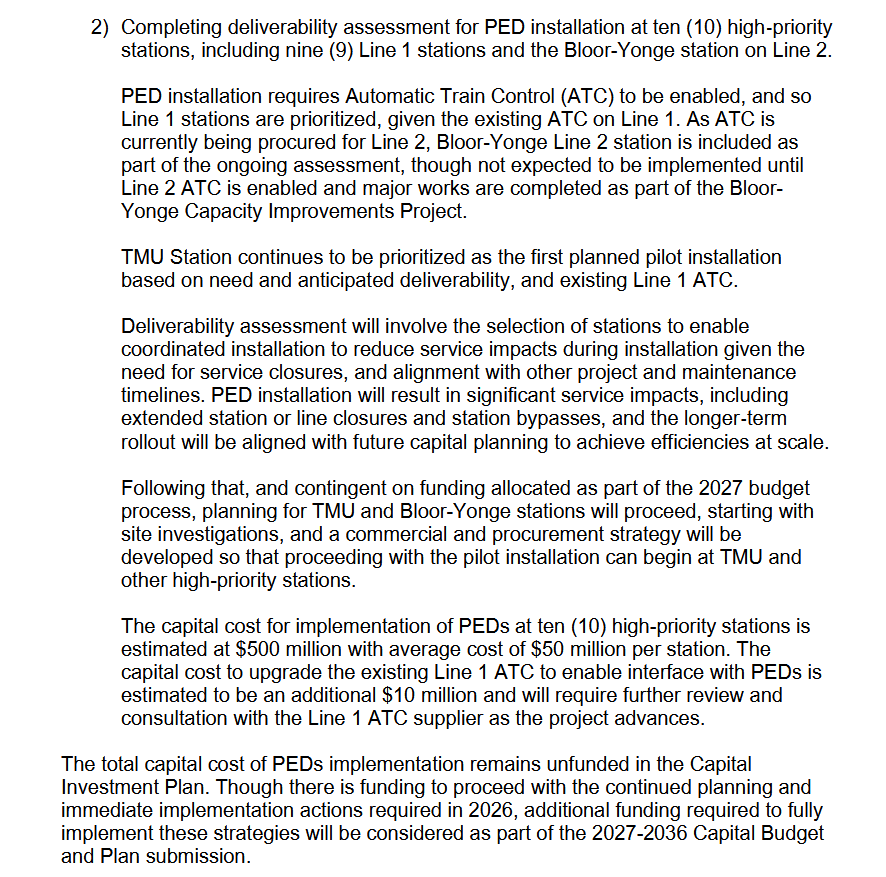
The intention is to pilot/rollout full PED at up to 10 stations, while doing something lower cost at another 10, guardrails with more advanced platform intrusion detection:
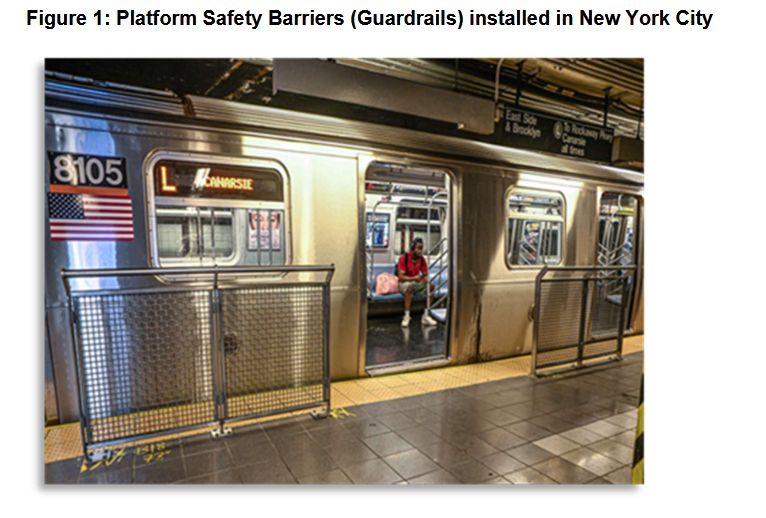
1779901594857.png

The above and below from the report linked above:
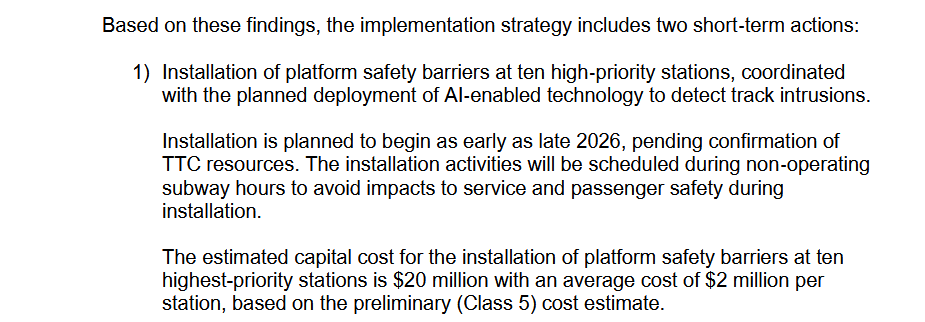
1779901639756.png


1779901681131.png

**

1779901719294.png
 
What exactly is the point of those fences? Might as well just put a sign saying "don't jump"
Grasping at straws here: helps when there are crowded platforms, so people don't get pushed onto the tracks accidentally. People would be more comfortable standing near the edge too, effectively increasing the platform space slightly.
 
Grasping at straws here: helps when there are crowded platforms, so people don't get pushed onto the tracks accidentally. People would be more comfortable standing near the edge too, effectively increasing the platform space slightly.
I can argue the fence makes it more dangerous as people could be crushed against it
 
FROM: https://www.cp24.com/local/toronto/...-toronto-subway-station-this-year-mayor-says/

A new pilot project will see steel barriers installed at one downtown subway station this year to prevent people from falling or jumping onto the tracks, an initiative similar to one recently implemented at subway stations in New York City, Toronto Mayor Olivia Chow announced Wednesday.

Chow said the barriers will be installed at TMU Station, located at Yonge and Dundas streets, steps from the Toronto Metropolitan University campus.

The announcement was made Wednesday at Bloor-Yonge Station by Chow and TTC CEO Mandeep Lali, who outlined a suite of safety measures being rolled out across the TTC.


In addition to the barriers, TMU Station will also be equipped with an AI-assisted early warning system camera that will help staff better detect issues at track level, they said.

In the Platform Edge Doors (PEDs) feasibility study released by city staff last summer, TMU Station was identified as the ideal station for a pilot project due to the “high incidence of track intrusions” and its status as one of the busiest stations in the downtown core.

“TMU Station offers an optimal location for evaluating the operational impact and effectiveness of PEDs under high-traffic conditions,” the study read.

“The station is located on Line 1, where the ATC system has been installed and is instrumental for the successful implementation of PEDs.”


The study indicates that it would take approximately 20 years and $4 billion to equip every station across the subway network with barriers.

Chow noted that it is not currently possible to install barriers at stations along Line 2 as the line does not have the Automatic Train Control (ATC) signaling system that ensures trains land in the same spot every time they arrive at a given station

The goal, Chow said, is to install barriers at four more subway stations along Line 1 next year.

When asked about the high cost for implementation, Chow conceded that other levels of government would need to step in to support that type of capital investment.

“We plan to do four more (stations),” Chow said. “The comprehensive system will need financial support from other levels of government.”

City staff said that the implementation of full-height barriers throughout the subway system could improve safety and operations in a number of ways.

“...the implementation of the full-height PEDs system throughout the subway network can mitigate unauthorized track intrusion, customer delay, injury and loss of life,” the study concluded.
 
Just out of curiousity, isn't there always some sort of buffer such that the stopping position doesn't have to be exact, even with PSDs? Would installing signage (stop markers etc.) at the stopping point help with manual driver alignment? Excuse the lack of technical knowledge - just wondering if ATC is a non-negotiable pre-requisite for PSD installation.
 
The fences actually achieve a neat psychological trick, which you can observe on the MTA.

On the one hand, the presence of these obvious barriers makes the gaps feel more dangerous, which encourages people to take the platform edge more seriously.

But while making parts of the platform feel more dangerous, they also make parts feel much safer. Passengers seem to love leaning against them, or even standing against them with their backs to the tracks. In this way, they encourage people to take up the entire platform width in these "safe" zones, and they also make the system feel safer specifically to people who aren't used to riding the subway. (To a downtowner, the subway is the subway, but to a visitor, walking along a crowded, 3-meter-wide platform while a train roars by, without any sort of barrier or protection, can make for quite an unpleasant sensation. Barriers of any sort help with that.)
 
Last edited:
Just out of curiousity, isn't there always some sort of buffer such that the stopping position doesn't have to be exact, even with PSDs? Would installing signage (stop markers etc.) at the stopping point help with manual driver alignment? Excuse the lack of technical knowledge - just wondering if ATC is a non-negotiable pre-requisite for PSD installation.
On planet Earth, you don't need ATC as a prerequisite for PSDs. However, in Toronto, it likely is IMO. Things need to be gold plated in unnecessary ways.
 
On planet Earth, you don't need ATC as a prerequisite for PSDs. However, in Toronto, it likely is IMO. Things need to be gold plated in unnecessary ways.

Errr, yes but?

Sure Osaka doesn't require ATC for operation of PEDS, but the PEDS system is very sophisticated and flexible able to oper doors in a wide range of positions and scans tags on the train for correct placement, replacing one advanced tech with another.

Shenyang Metro & Guangzhou Metro also employ PEDs w/o full ATC, however, the stopping tolerance is very small, and requires relatively low speed operation within the station which does discount headways slightly. TTC frequency timing is generally predicated on entering stations at or near full speed.

So, in fairness to the TTC, I do think ATC is necessary for PEDS here based on presumed operating style and frequency.
 
So, in fairness to the TTC, I do think ATC is necessary for PEDS here based on presumed operating style and frequency.
^Exactly my point. Thank you for clarifying. I believe non-automated/less automated lines + PSDs make for very long dwell times in China. I've personally experienced 50 second dwell times from stop to go. Doubling the dwell times would not be acceptable for Line 1 as it would make trips even longer, and given the relatively tight stop spacing. Hence the need to gold plate things. But it already has ATC, reaching GoA2 at least.

I don't think PSDs on a line later upgraded to GoA2, St. Petersburg-style would fly here:

^30 second dwell times by the way.

On gold plating, there is nothing physically stopping them from installing PSDs before ATC is implemented on Line 2. And Line 2 is driven much faster to begin with, so longer dwell times would be less noticeable.
 
Last edited:
There are, of course, several variants of PEDs - some are doors in low fences, some are real barriers from floor to ceiling. I assume we are looking at doors in lowish fences because for full 'door walls' one then faces challenges with air flow and ventilation. Though Toronto seems to veer between doing things in the cheapest way possible (in this case low doors/walls) and the most expensive (full doors in high walls) I think this is low doors and low walls project If the primary aim is stopping people being pushed onto the tracks a low wall is fine, if it is to stop suicides, a slightly higher wall is probably required and if it is also to stop 'stuff' being blown onto the tracks and causing fires the walls need to be higher still
 
Last edited:

Back
Top