News   GLOBAL  |  Apr 02, 2020
 11K     0 
News   GLOBAL  |  Apr 01, 2020
 43K     0 
News   GLOBAL  |  Apr 01, 2020
 6.8K     0 
Regarding average speed, you can't come to any useful conclusion comparing a suburban LRT with the entire subway system including slower downtown sections. The Eglinton West LRT is entirely suburban so even if it stops at red lights it will have somewhat decent speeds. With grade separations and/or pre-empting traffic lights, it would be faster. Probably the best subway comparison would be Line 4, which is also entirely suburban and has fairly wide station spacing. There's really no significant difference between subway and LRT technologies in terms of speed - each would be about the same with the same design and operating environment.

"Rapid transit" has now devolved into a fairly useless term. A mixed traffic bus with wifi can be considered rapid transit. And LRT has gotten pretty useless too, so I can't agree that there's such thing as "actual LRT". Look at the Line 3 upgrade plan. Was 100% separate from traffic, using 100m trains, automated, local-ish station spacing, very high capacity, low fares, ~2-5min frequency day and night. That's a subway. Split hairs and call it a light metro, but whatevs still a subway by most metrics. Nowhere did I hear those terms in any debate or report. No light metro, no intermediate capacity system, no subway, no light subway, etc. Very little underscoring of its traits. Just "LRT".

But then we have Harbourfront LRT, Spadina LRT, new Watefront LRT. And I guess St Clair too. All in the roadway stopping at traffic lights every 50m, all great upgrades, but all 'actual LRT'. That famous Matlow debate where he supposedly schooled Ford, IMO he just added confusion to an already confusing concept. If a line running with a slow order next to a sidewalk is an LRT, and Line 3 upgrade is LRT, then there's clearly no such thing as "actual LRT". It's such a broad and vague term.

This is the main reason I'm supportive of continuing with the current plans for Eglinton West. We already firmly chose 10yrs ago that the line must have an "LRT" monicker no questions asked, and skipped any opportunity to re-analyze when we had the chance (even if it could've saved us subsequent issues namely SSE). We made our bed. May as well just continue with it.
LRT's versatility is simultaneously its strength and weakness. Depending on how it's designed, it can run the same way as a streetcar or a subway or even a commuter train. And sometimes all three on the same line. Its versatility means it can be designed in different ways depending on local conditions. The weak side of that versatility is that nobody knows just what an LRT is until they're riding it. You can market a glorified streetcar as "rapid transit" or "metro" and people will be pissed when they ride it for the first time and find out how slow it is.
 
Regarding average speed, you can't come to any useful conclusion comparing a suburban LRT with the entire subway system including slower downtown sections.

Line 2 between Kipling and Victoria Park runs at 28 km/h. Line 4 is 29 km/h. Line 5 underground is 32 km/h. All three of these lines have fairly uniform stop spacing and speeds, so they're fine to use as a comparison to Eglinton West LRT.
 
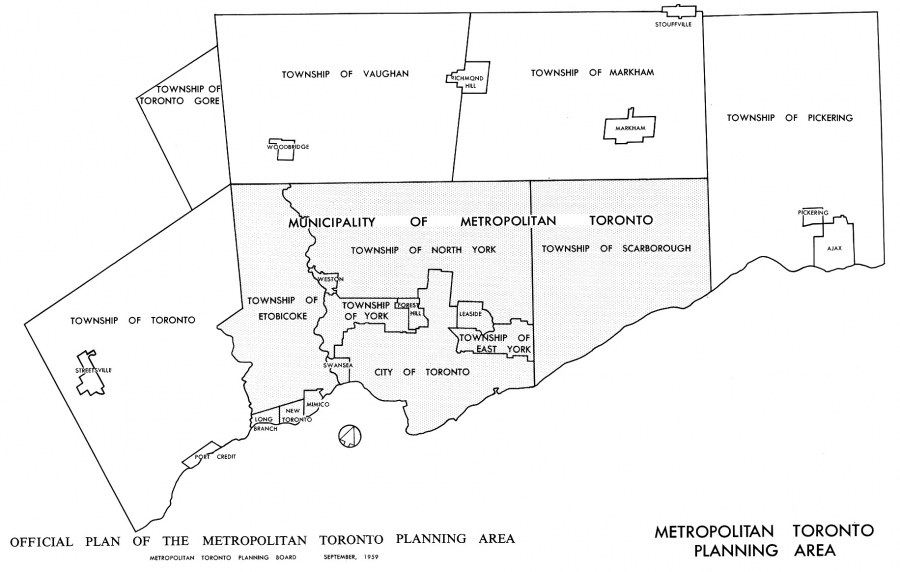
Just realized that the Eglinton Crosstown would be outside the boundaries of 1911 City of Toronto.
metro_1953_008.jpg


4_1959_metro_planning_area.jpg


With the Eglinton West LRT, the Crosstown would have crossed all of the old cities and borough of Metropolitan Toronto.
Toronto_map.png
 
Just realized that the Eglinton Crosstown would be outside the boundaries of 1911 City of Toronto.
And it would have also been inside it, no?

It is funny. If Toronto had grown a little quicker before the turn of the century, then Eglinton may have been a streetcar'd route, just like St. Clair.
 
And it would have also been inside it, no?

It is funny. If Toronto had grown a little quicker before the turn of the century, then Eglinton may have been a streetcar'd route, just like St. Clair.

Actually, the OAKWOOD streetcar did run on Eglinton Avenue West, from Oakwood Avenue (OAKWOOD STATION) west to the Gilbert Loop (CALEDONIA STATION). See link.
 
More than anything, I’m stunned by the low opposition to the project. Certain Etobicoke councillors seem to have greatly overestimated how much their constituents would oppose this project.

I feel like a decade ago, there would’ve been a lot more opposition.
I thought this would be good news. Try and sound more pleased.:)

I think a great deal has changed in that intervening decade. Getting around is decidedly less pleasant and we have witnessed a competent mayor, a shit-show, and a know-it-all in those years. The need to improve mobility, manage growth and treat the environment better has not diminished.
 
Eglinton Crosstown wall collapse nets demolition company $60,000 fine

I witnessed this collapse happen before my very eyes. As I saw that wall come down, I thought I had witnessed the death of several people. If I had decided to walk on the north side of Eglinton Avenue that day, I likely would've been under that rubble as well (the building collapsed directly opposite from where I was standing on south-side Eglinton Avenue West). It really put into perspective how quickly and unexpectedly your life could be extinguished.

I don't know if a $60,000 fine is enough for this extremely life-threatening event. That said, I'm very pleased that nobody was seriously hurt in this example. If it had not been for the scaffolding protecting the pedestrians from the falling debris - forming a protective bubble between the rubble and the pedestrians - it likely would have been a much worse outcome.
 
Just realized that the Eglinton Crosstown would be outside the boundaries of 1911 City of Toronto.
metro_1953_008.jpg


4_1959_metro_planning_area.jpg


With the Eglinton West LRT, the Crosstown would have crossed all of the old cities and borough of Metropolitan Toronto.
Toronto_map.png
Pretty much every rapid transit expansion in the last several decades has been outside those boundaries, despite that being where the most demand and overcrowding are.
 
Eglinton Crosstown wall collapse nets demolition company $60,000 fine

I witnessed this collapse happen before my very eyes. As I saw that wall come down, I thought I had witnessed the death of several people. If I had decided to walk on the north side of Eglinton Avenue that day, I likely would've been under that rubble as well (the building collapsed directly opposite from where I was standing on south-side Eglinton Avenue West). It really put into perspective how quickly and unexpectedly your life could be extinguished.

I don't know if a $60,000 fine is enough for this extremely life-threatening event. That said, I'm very pleased that nobody was seriously hurt in this example. If it had not been for the scaffolding protecting the pedestrians from the falling debris - forming a protective bubble between the rubble and the pedestrians - it likely would have been a much worse outcome.
The House of Chan façade was as sturdy as one made from playing cards.
 
Pretty much every rapid transit expansion in the last several decades has been outside those boundaries, despite that being where the most demand and overcrowding are.
Rapid transit expansions took too long from planning to opening that by the time they opened, the travel pattern and demographics of the areas they are to serve had changed drastically. Remember Network 2011? Idea came during the mid-80s and it took nearly two decades to just finished a stub of a line.
 
Rapid transit expansions took too long from planning to opening that by the time they opened, the travel pattern and demographics of the areas they are to serve had changed drastically. Remember Network 2011? Idea came during the mid-80s and it took nearly two decades to just finished a stub of a line.
Yup, and many plans have fallen victim to lobbying and politics. Travel patterns have changed in some ways, but I'd argue that rapid transit expansion hasn't followed demand at all. The demand has always been greatest downtown even as lines got extended farther and farther away. I'm all for the Crosstown of course, I'm just pointing out that transit expansion outside the old city is nothing new.
 
Those complaining that the "downtown elites" keep getting the "good stuff" is plain wrong. Most of the "improvements" have been in the "suburbs". Time for the "downtown elites" to get their turn with the Crosstown LRT and the Relief Line. And as shown, the old "suburbs" (IE. town of North Toronto) are now "downtown".
 
^To add to that point, there are people from Oakville, Burlington, and Hamilton who think they're not in Toronto until they are around the Exhibition area. Other people dont even know that Toronto has a midtown, and think that the entire spine of Yonge Street is "Downtown". Generally speaking, these people have a poor concept of how cities are made up.
 

Back
Top