





BurlOak
Senior Member
Like this? If you read the desciption, the Red not is Oxygen, and the 2 blue ones are Hydrogen, to represent a water molecule. (although I though the angle between the two is too flat.

|
|
|

Like this? If you read the desciption, the Red not is Oxygen, and the 2 blue ones are Hydrogen, to represent a water molecule. (although I though the angle between the two is too flat.

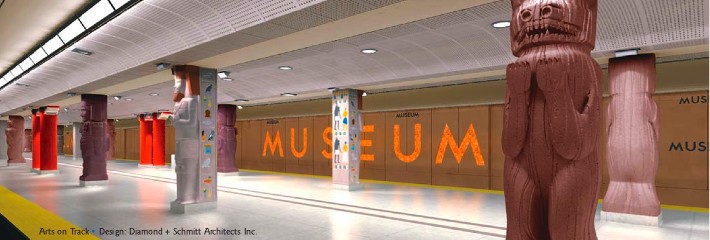
I'm impressed with the refurbish of the Museum Station. It initially struck me as tacky, but with the new tiles and colours, it really works, and in a relatively compact space.
Yes, it could very well be...quite a few TTC stations, even the newest ones, seem to have a massive blind-spot in finishing them. It doesn't take much to throw-off the entire visual effect by overlooking what's 'above your head'. I'll check that out next time through there. If that does ruin the look, it would be very easily remedied. lol...easy to say...we are dealing with the very cash-strapped TTC.Just don't look at the ceiling. It looks like its unfinished.
http://www.blogto.com/city/2016/05/the_best_and_worst_ttc_subway_stations_in_toronto/BEST
Dupont
Opened in 1978, Dupont is a perennial favourite of TTC riders for its mosaic tiles, dome entrances, and built-in benches. The attention to detail here is far greater than at the vast majority of stations on the line, for which kudos should go to Dunlop-Farrow Architects.
Rosedale
Stop and consider how well Rosedale Station is integrated with the natural landscape in which it sits the next time you pass through. Its rounded entrance has an understated mid-century elegance, which was even more apparent with its original Vitrolite tiles.
Old Mill
Many would argue that Old Mill is the fairest TTC subway station of them all on account of its predominantly glass walls that look out over the Humber Valley. Unlike Rosedale, there's some protection from the elements at platform level, but you still feel outdoors.
Downsview
The nicest of the new(er) TTC stations, Downsview was designed by Adamson Associates Architects and Stevens Group Architects and opened in 1996. Many have noted it has an airport-like feel, though I've always loved the way that that ceiling is rounded at platform level before opening into a multi-storey atrium on the way to the bus bays.
Eglinton West
I've heard this station derided for its ugly concrete, but it's hard to argue against its modernist aesthetic when driving south on Allen Rd. Built into the mound that takes drivers off the freeway and onto Eglinton Ave., this Arthur Erickson design is in fact a lovely bit of architecture, including the original platform-level windows and the green roof added in 2009.
Queen's Park
The closest you'll get to riding the London Tube in Toronto is Queen's Park and its sister station St. Patrick, both of which were hollowed out using a tunnel boring machine so as to lessen the impact of construction on the nearby hospitals. Which station one prefers is usally a matter of colour preference, though the newer second entrance at Queen's Park edges it for me.
Museum
Oh, Museum. Sure to be the most divisive entry on this list, some love the quirky themed design while others lament the loss of a near perfectly preserved 1960s subway station. For my part, I think the novelty of the design is worth kudos even if the budget never allowed for the work to seem entirely finished.

Just don't look at the ceiling. It looks like its unfinished.
The TBM cutter head from Don is now out of the tunnel.


Pics or it didn't happen
Is video better than pics?Sorry no pics. I guess it means that the TBM head is still underground.

Many thanks for that! I wondered what they had intended. As well as visual, it looks like that also has acoustically absorptive properties, and disperses light horizontally.I know, right. The ceiling was supposed to look like this:
But like seemingly everything with the TTC, from the non-tiled platform walls in newly constructed stations and lack of grade-separation at the Leslie-Eglinton intersection, pinching pennies seems to be The new Better Way.
Paris began its first experiment with driverless buses on Monday, with city officials saying they were eager to prepare for the coming "revolution" of autonomous vehicles.
Two box-shaped electric vehicles capable of carrying around 10 people have been deployed -- within the safety of a special lane -- on a bridge connecting two railway stations to the east of the city centre.
"Autonomous vehicles represent a revolution for every city on the planet... which will change our urban environment and public space in a spectacular fashion over the next 20 years," Paris deputy mayor Jean-Louis Missika told reporters.
The test unveiled Monday, which will last three months, is the first stage of the city's embrace of self-driving vehicles which use a combination of lasers and cameras to detect other objects and people around them.
The head of the Paris transport network, Elisabeth Borne, said she envisaged the buses being used one day to connect homes and railway stations in the suburbs, which are served by overland trains known as RERs.
"We dream one day of having buses like these parked near RER stations which would come to collect passengers on demand," she told reporters at the launch.
The advent of self-driving vehicles poses a series of regulatory, ethical and economic questions which policymakers will have to grapple with as the technology improves and grows more widespread.
One of them is: What happens to the humble bus driver?
"We need to start thinking from today about how to train drivers so they can shift into the new jobs created by autonomous vehicles," Missika, who is a transport expert in the mayor's office, told AFP.
In October, delivery drivers got an uncomfortable glimpse of the future when a self-driving truck built by Uber's Otto unit successfully delivered a beer shipment.
Cars with some autonomous functions are already on our roads, and more than a dozen automakers including BMW, Kia, Volkswagen and General Motors are racing to get fully self-driving cars to market by 2020.

