TheTigerMaster
Superstar
There goes the last Vitrolite tiles
Are the Vitrolite tiles in Eglinton the original tiles from 1954, or have they been replaced since then?
|
|
|
There goes the last Vitrolite tiles
Reviewing the Yonge-Eglinton Station designs from back in December 2013, from this link, I'm listing some interesting points of interest.
View attachment 55195
- A 70 metre shift north to the existing subway platform
- Excavation at Yonge-Eglinton to start early 2016
- Station construction to start spring 2017
- approximately 50 weekend subway closures over a period of approximately two years, starting July 2016
- LRT and mezzanine levels (two levels) to go under subway level
And from this link, this illustration of the Yonge-Eglinton interchange.
View attachment 55199
With a possible 50 weekend subway closures at Yonge-Eglinton, does show that the powers-that-be should include a station box at Don Mills-Eglinton, even in a rough state. Use it for storage, until needed.

Due to this closure, a lot of 32 Eglinton West riders will divert to Eglinton West station on Spadina Line, rather than Eglinton Station on Yonge Line. Hopefully Eglinton Avenue West at Allen Road will be fully opened by then, so that the 32 Eglinton busses can get into Eglinton West station easily. Currently, there are long queues outside of Eglinton West because of the construction.


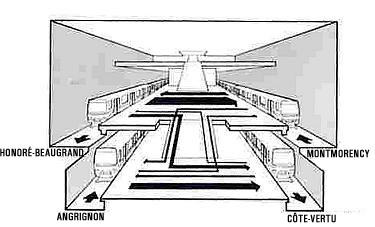
While the current design is currently an improvement, I'm not convinced designing the interchange with a single centre platform on each lines is optimum. I know that space along Yonge is at a premium, but I'm surprised they can't find a way to stagger the platforms, so that (for example) one platform is entirely north of Eglinton and the other entirely south. Though maybe that would be equally as bad for passenger flow - though wouldn't result in the same platform crowding.Vitrolite titles vs. poorly designed interchange hell like Yonge-Bloor. The choice is easy.

The current Eglinton Station has 10 bus routes serving it. Can't see all of them diverting to Eglinton West.
It's pretty easy. You deflect each line by 45 degrees, so that the station is on an angle to both Don Mills and Eglinton. With all the parking lots and empty land at that intersection, it's not difficult. Might even help deflect the Don Mills line, to the obvious place for a station north of Eglinton - Wynford and Concord.Difficult to do unless your station is sited in such a way that allow trains from both lines will be going in parallel close to the station area. Not sure how that can be done in this case given the area in question.
It's pretty easy. You deflect each line by 45 degrees, so that the station is on an angle to both Don Mills and Eglinton. With all the parking lots and empty land at that intersection, it's not difficult. Might even help deflect the Don Mills line, to the obvious place for a station north of Eglinton - Wynford and Concord.
While the current design is currently an improvement, I'm not convinced designing the interchange with a single centre platform on each lines is optimum. I know that space along Yonge is at a premium, but I'm surprised they can't find a way to stagger the platforms, so that (for example) one platform is entirely north of Eglinton and the other entirely south. Though maybe that would be equally as bad for passenger flow - though wouldn't result in the same platform crowding.
Just look at all the asphalt deserts around the Don Mills-Eglinton stations site, being used a parking lots at present.
View attachment 55201
Especially, the southeast corner used by the Science Centre provides plenty of space. A diagonal alignment of the Eglinton Crosstown LRT, with provision for any kind of Don Mills/DRL/whatever line using extreme measurements for any kind of equipment to could use that line, is better now. Afterwards, infill buildings or expansions will make putting a transfer station will be more difficult.
They should design the interchange stations at Don Mills-Eglinton NOW to better handle the transferring of passengers than what they do now.

It's a pretty standard practice to turn lines so that they are parallel when two lines that are planned simultaneously intersect. As Toronto did for both the St. George and Bay intersection stations; though they'd have worked better if they'd have stacked the tunnels, they still work far better than simple crosses such as Eglinton-BloorIt's probably unnecessary considering these type of solutions isn't required where is far higher projected riderships. Far better to focus on implementing the Island platform with more generous spaces and circulation elements.