





Jane2021
New Member
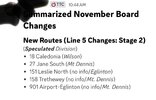
Line 5 Changes stage 2 effective November 16th
|
|
|

But not combining the 51 Leslie/56 Leaside yet. I guess there's a stage 3 coming. I'm surprised they'd bother with the 151 until then. TTC just doesn't get that frequent changes to the same routes only confuse and frustrate customers. They don't magically adjust instantly ... which is what the one report for this months meeting noted for King/Queen bustitution, with a tone of surprise. Perhaps the reason there's not enough 503 buses on King downtown currently - because their model says they'll use Queen ... well maybe by 2027 ...Line 5 Changes stage 2 effective November 16th
View attachment 693198
I am making the assumption that headways shorter the 3-3.25 minutes are not possible right now. All hypotheticals, but as someone has mentioned, they could short turn at Laird to crank up frequencies for the west underground section at the cost of doubled headways in the east, which is not entirely unreasonable given the population distribution.How does using 3 car trains rather than 2 car trains help with capacity when the total number of cars does not change? Is that because the system cannot handle headways shorter than 3 minutes or so? Or is it because the number of drivers is capped?

I know this is off-topic, but I wonder if and when we will catch up to/surpass Los Angeles.As a geek, I just don't think it's possible that a pre-covid Metrolinx or anyone else was able to predict a 10%+ surge in Canada's population in the span of 4-5 years from 2021 after the stagnation/decline in 2020. Something like 14% population growth in GTHA and 17% in Toronto proper up to 2024 at least. Stats Canada has Toronto's population at ~3.3 million as of July 1, 2024 without factoring in the full extent of undercounted visas and overstays. Our roadside signs still read 2.7 million since the census. Not a single population projection in the last 15 years of Metrolinx's publications or news releases indicates that they foresaw 15 years of growth in 5. I don't think anybody predicted this was going to happen, even the IRCC and its Minister.
Speculation:
Hypothetically, if we get 1% annual growth in the GTHA after 2027, we could still hit 10 million in the GTHA by 2031 as opposed to 2041. Potentially 9.5 million if we assume Mr. Ben Tal from CIBC is dead wrong about population undercount.
Article from Oct 20:
'He warned that the current immigration policy had led to undercounting of non-permanent residents, which in turn distorted housing demand forecasts.
“We [have] more people in the country than you think. People say we are 41 million. No, we are 42 million in the country. But we are not counting one million,” Tal said.
Statistics Canada’s official estimate for Canada’s population as of Q2 2025 was about 41.6 million.'
https://www.mpamag.com/ca/mortgage-industry/industry-trends/we-are-in-a-recession-cibcs-tal/553608
https://economics.cibccm.com/cds?id=858756bd-a8fc-4920-8ea4-e1dcd1c104d4&flag=E
https://www150.statcan.gc.ca/t1/tbl1/en/tv.action?pid=1710015201
Then again, RTO is not fully in effect and TTC ridership is still down from pre-covid. It really is hard to say how high ridership will be.
P.S. the original debate was about route capacity, and how exactly Line 5 Eglinton was supposed to meet its own goal of hitting 15,000 passengers per direction per hour with its rolling stock.

Never. LA county is bigger population than allI know this is off-topic, but I wonder if and when we will catch up to/surpass Los Angeles.
What are you thinking of by handed over to the ttc? I thought that the handover had already happened and that was when training started. Currently if I understand correctly the TTC is running the revenue service demonstration which is the last stage before opening.Any word on when this is being handed over to the ttc? What’s the latest holdup? This thread will be beside itself the day it finally happens.
Line 5 operations are currently based out of the TTC Hillcrest central control facility, but the line has not been legally handed over yet to the TTC.Any word on when this is being handed over to the ttc? What’s the latest holdup? This thread will be beside itself the day it finally happens.
Most of it, other than some stuff at the transfer stations will remain under Metrolinx ownership. TTC isn't doing maintenance, etc. - that's for Metrolinx.Line 5 operations are currently based out of the TTC Hillcrest central control facility, but the line has not been legally handed over yet to the TTC.
LA County? The 2024 population is listed as about 9.8 million. The GTHA population 2024 population estimate is 8.3 million. And the Ontario mid-2024 estimate was 16.1 million. Meanwhile LA county is about 30% bigger in area.Never. LA county is bigger population than all
of Ontario. Toronto will
Never get there as we don’t have the ECONOMY of LA to support such massive growth.
when it has been legally handed over after RSD is complete, similar to what recently happened with Finch.What are you thinking of by handed over to the ttc? I thought that the handover had already happened and that was when training started. Currently if I understand correctly the TTC is running the revenue service demonstration which is the last stage before opening.
I'm not sure what benefit would be derived from mixing 2- and 3-car trains. From a passenger standpoint, it is better to run shorter trains more frequently, as that reduces the amount of time waiting for the next train. Conversely from the TTC's standpoint, running longer trains less frequently is better as that reduces staffing requirements and thus direct operating costs. Mixing trains seems to arrive at a "worst of both worlds" situation.Was thinking ideal scenario to point out that some combination of 2 and 3 cars could be possible to run on Day 1 to maximize route capacity. If 95 minutes is the realistic round trip time, then we could do 21 two car trains and 8 three car trains at 3.25 min or something similar to keep 7-10 spare cars? Do you think having such a low spare ratio is feasible?
As a passenger, the only issue I've had with a mix of short-trains and long-trains (at different times of the week), is the running from where you are standing to the train. I've had this on GO during the pandemic (easier now that the screens show the train length), on the New York subway, and on Line 1 when they used to run the shorter trains on weekends.I'm not sure what benefit would be derived from mixing 2- and 3-car trains. From a passenger standpoint, it is better to run shorter trains more frequently, as that reduces the amount of time waiting for the next train.
I'll try some napkin math with a higher spare ratio. I understand TTC Line 1 and 2 both have a 25+% spare ratio currently. Reasons not worth mentioning right now. But let's say 95 minute round trip, 56 of 76 cars are used on 28 trainsets, that means peak headways 3.4 minutes and peak capacity between 5,600 and 8,800 passengers per hour per direction with each two-car trainset carrying 320 to 500 passengers (depending on density).I'm not sure what benefit would be derived from mixing 2- and 3-car trains. From a passenger standpoint, it is better to run shorter trains more frequently, as that reduces the amount of time waiting for the next train. Conversely from the TTC's standpoint, running longer trains less frequently is better as that reduces staffing requirements and thus direct operating costs. Mixing trains seems to arrive at a "worst of both worlds" situation.
The normal spares ratio for modern equipment is 20% to 25%. On a 76 car fleet, that means that they will want to keep somewhere between 15 and 19 cars on hold from service at the peak times.
Dan
Before Covid, Line 1 had 65 trains in service at peak. And there are 76 train-sets. That's a 14.5% spare ratio.I'll try some napkin math with a higher spare ratio. I understand TTC Line 1 and 2 both have a 25+% spare ratio currently. Reasons not worth mentioning right now. But let's say 95 minute round trip, 56 of 76 cars are used on 28 trainsets, that means peak headways 3.4 minutes and peak capacity between 5,600 and 8,800 passengers per hour per direction with each two-car trainset carrying 320 to 500 passengers (depending on density).