News   GLOBAL  |  Apr 02, 2020
 11K     0 
News   GLOBAL  |  Apr 01, 2020
 44K     0 
News   GLOBAL  |  Apr 01, 2020
 7K     0 
Waterton
IMG_9217.JPG
IMG_9227.JPG
 
Recently went to the UK for a couple weeks and spent some time in Glasgow, Manchester, Liverpool, and London. Some thoughts and photos below:

Inspiration for the former Rossdale Power Plant:
- Battersea Power Station (London): They have turned this former coal power station into a fairly large shopping centre with an auditorium and large outdoor plazas and adjacent development on the outside of it, including an extension of the Northern Line. It is actually spectacular what they have done here. The total development costs were around $10 billion (unsure what currency) with $1.28 billion spent on the repurposing of the building itself. At a minimum I think that we could be more creative with projection and lighting on the exterior. A similar power station in London was turned into the Tate Modern Art gallery.
PXL_20251210_170718874.MP.jpg

- Royal Albert Dock (Liverpool): Not a direct comparison but Liverpool has been working to develop the Royal Albert Dock into a destination with dining, shopping, and museums including the Tate and Beatles Story.
PXL_20251201_132258812.MP.jpg


Examples of architecture and other general development that I encountered that would look great in Edmonton (warning, lots of brick!):
- Kampus (Manchester): Never got a good picture of it but this was a cool development, similar to something like Stationlands, where they've integrated some community space in the centre with restaurants and shops. The central community space was programmed with a dance party when we were there in the spring. Loved the use of red brick throughout. If you're ever in Manchester, go to the Great North Pie Co. as it is fantastic.
- Misc Manchester developments, mostly midrise-ish. They utilized brick and stone of different colours everywhere in the City, and the other material colours seemed to kind of honour that colouring. There were also several buildings that reminded me of what was done at the Revllion-Boardwalk building - large atrium style buildings in former industrial (e.g. mills) or warehouse buildings. Would be great to get more of that.
PXL_20251205_095600063.MP.jpg

PXL_20251204_133927413.jpg

PXL_20251204_130913781.jpg


Lastly, we found that they just utilized light and colours extremely well at night time. They are all at a similar latitude to Edmonton and Calgary so also have long winter nights. Seemed like every street had some sort of light display, whether it be suspended above the street or sculptures along the sidewalks. Sometimes it feels we are scared to use too much light.
- Liverpool
PXL_20251201_160655929.jpg

PXL_20251201_184337683.MP.jpg

- Glasgow
PXL_20251205_172421552.jpg

PXL_20251205_173354329.jpg

- London
PXL_20251209_162808636.jpg
 
I've spent most of the past month in rural Lincolnshire, London, Mumbai, and rural Gujarat. I wanted to share some photos from Mumbai because I suspect that Canadians know much less about it than other comparable megacities.

Mumbai has a lot of problems, including traffic, pollution/trash, lack of green space, sky-high housing costs, lack of mixing between ethnicities/religions, and staggering inequality. (Also, the streets are not safe for pedestrians... or cyclists, or drivers. But people still do all of those things.) However, it's improved considerably in the past couple decades, and the street-level feel has always been incredible.

An interpretive boardwalk trail through a forest in the posh neighborhood of Malabar Hill:
20260108_183532.jpg


Much-beloved Priyadarshini Park, also in Malabar Hill:
20260109_173026.jpg

20260109_172647.jpg

20260118_172119.jpg


A view from above in the somewhat upscale, redeveloping northern suburb of Borivali:
20260111_140458.jpg


I liked the design of this tower parkade in Borivali:
20260112_165541.jpg
 

Attachments

  • 20260111_140354.jpg
    20260111_140354.jpg
    233.4 KB · Views: 21
Some street views of the more tourist-friendly bits of South Bombay (Colaba, Fort, South Bombay...). Here I leave out some of the more iconic buildings (Victoria Terminus, Taj Hotel, etc) since that's not the point of this thread. Most of these photos were taken through the dirty window of a double-decker bus, so please excuse the quality.

In the photos below and above, you'll mostly see four styles: British colonial with Indian influences, Art Deco, practical Bauhaus-y high modernism, and a sort of ornamented, slightly Islamicized architecture for some of the more opulent new towers that I think of as 'Dubai-core.'

20260120_164018.jpg

20260120_160701.jpg

20260120_164217.jpg


Art Deco midrises lining Marine Drive
20260120_165448.jpg


Cricket pitches on the Oval Maidan, with the main campus of University of Mumbai in the background.
20260120_171104.jpg

20260120_172522.jpg

20260120_173537.jpg

20260120_164620.jpg

20260120_173648.jpg


And some views from the ground
20260120_175039.jpg

20260120_175633.jpg
 
I realize I'm already well into the self-indulgence zone, but I wanted to share some of my experiences on Mumbai transit. I've mostly gotten around by car, but I did make a point to take the bus (my first time in ~10 yrs) and metro (my first time ever!). I did not take the local railways, which are how the masses of poor to lower-middle class get across long distances (and even upper-middle class, since the metro is still poorly connected and the buses are too slow for long commutes). I have seen inside some of local railways cars, and they are packed, even in first class.

For reference, a second-class local railway trip would be around 5 rupees, first-class would be more like 80 rupees, the bus cost 10 rupees for my short ride, the metro is comparable to first-class railway. The metro and bus are fare-zoned; not sure about the local railways. 1 CAD is about 70 rupees.

Here's the inside of a bus. Riders tend to board from the back and don't scan or deposit money upon entering. Instead, a conductor comes around to collect fares based on your destination. This gets a bit hectic when 20 schoolkids board at once, and I'm sure some of them manage to get off without paying. Many of the buses have been upgraded to have cushioned seats and air conditioning in the last 10 years; this one hadn't. There's a bell to ring, but only the conductor ever rings it. Rather than indicating that you want to get off, it tells the bus driver to keep going after a stop.
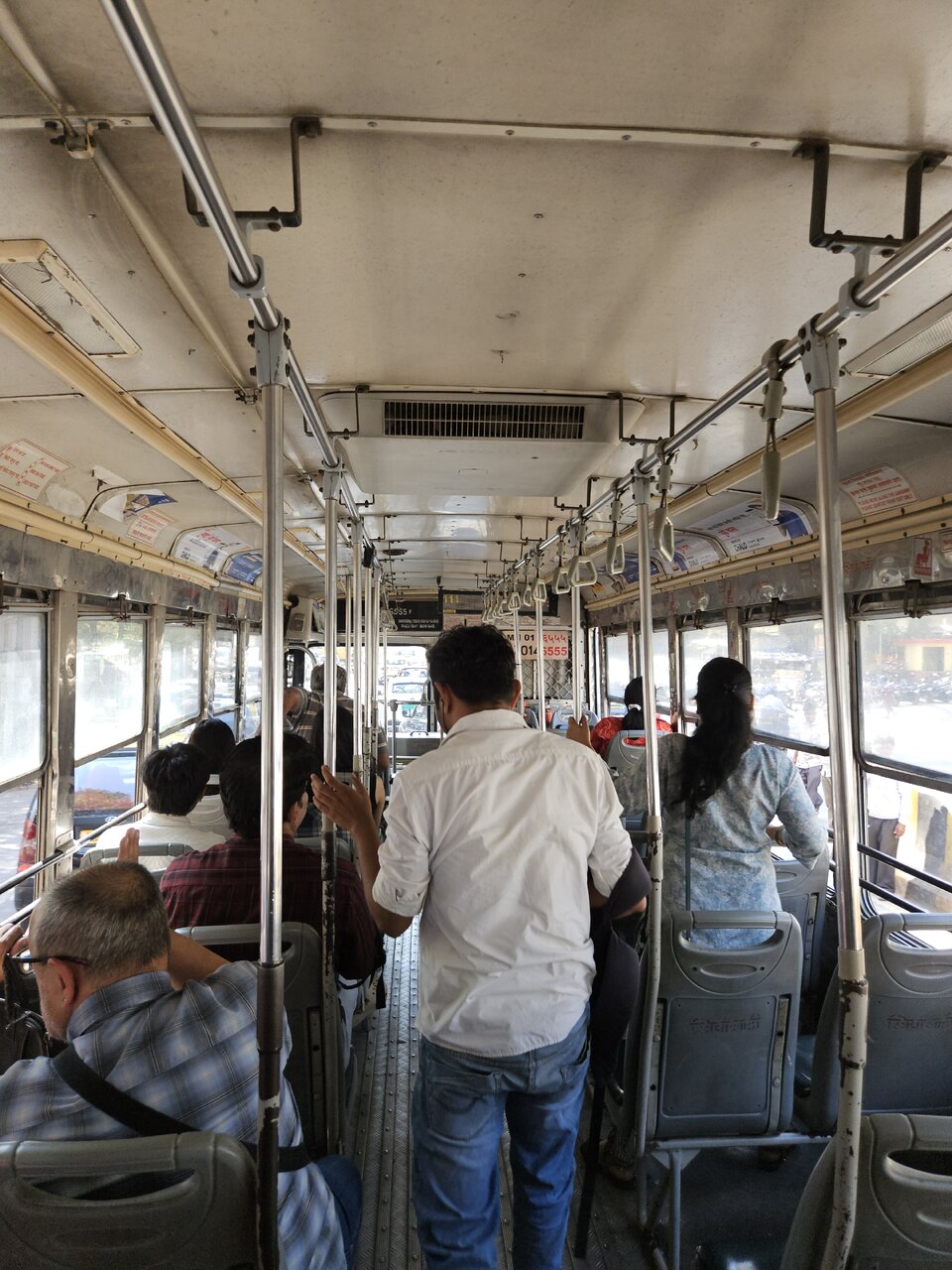
20260128_135024.jpg


Here are some photos from a trip on the metro's Aqua Line. This is the only line in Mumbai to run underground; the rest are elevated. (There is no space in Mumbai for a surface train.) Note that Mumbai's metro is very much under construction, which I hope will relieve the problems with connectivity. This line, which connects Colaba/Cuffe Parade (the most touristy area) to the special economic zone of SEEPZ in central Mumbai, opened in 2024 and is still being extended. The ridership is low, partly because it's so new, partly because the whole network's connectivity is low, and partly because the fares are out of reach for many poorer people.

My trip was between the historic Marathi stronghold of Dadar and Girgaon, the area around Chowpatty Beach. The metro stations are all mostly decked out in millennial grey granite with harsh LED lighting, but they're clean and well-maintained.

Here's an entrance:

20260129_144800.jpg

20260129_144718.jpg


Staffed ticket counter and help desk. Signage is generally in either Marathi and English or Marathi, Hindi, and English.

20260129_163007.jpg


Everyone has to pass through security—separate lines for ladies and gentlemen. (Since the 2000s terrorist attacks, there's security everywhere.) The fare gates require scanning a QR code, either from your phone or from a paper ticket purchased at the counter.

20260129_163102.jpg

20260129_144508.jpg


Descending a couple levels to the platform: look at those screen doors!

20260129_142834.jpg


The train arrives. Here you can see a retractable belt demarcating a ladies' section, mostly for women traveling alone.

20260129_142743.jpg

20260129_143155.jpg


Finally, a couple views (from inside a car) of some elevated lines. These are Mankhurd and Deonar stations on the elevated Yellow Line.

20260130_073623.jpg

20260130_073440.jpg


And this is (I think) RBI Colony station in the Navi Mumbai Metro. Navi Mumbai is one of the larger Mumbai suburbs; it currently has one line, which is being extended, and another under construction. Currently no metro connectivity to Mumbai proper's network.
20260130_075552.jpg
 

Attachments

  • 20260129_142419.jpg
    20260129_142419.jpg
    273.4 KB · Views: 29
  • 20260129_142359.jpg
    20260129_142359.jpg
    234.5 KB · Views: 25
Experiencing the local tableau has always been my M.O. when traveling. Beautifully done @constance_chlore! It would be interesting to know your emotional takeaway on these various modes.
A few thoughts: I'm uncomfortable about the quite explicitly two-tiered system, in part because I get it. I've seen inside the local railways, and I've been in the middle of crowds of people who spit paan juice and smell like sweat and hair oil. I don't love it!

Part of the issue is that many of the recent, expensive infrastructure buildouts have been oriented towards things that only the middle class-and-up minority can use. This includes not just the metro but other big projects like the Coastal Road and Bandra-Worli Sea Link, which are entirely about easing car journeys in a city where a minority of residents can afford a car. Poverty in India has declined a lot, but for most people paying 50+ rupees for a long metro journey is out of the question. Meanwhile, for everyone I know in India, 50 rupees is nothing.

I wonder what it would have looked like if the city/state governments had instead decided to spend this money on improving the capacity of the overcrowded local railways. But it feels as if there are no incentives to do that right now.
 
^ Thank-you. I have an Indian client who is building 2 houses in a fire section of Malibu, California. He is originally from the Bengal State of northeast India and I love to get into long conversations of learning about his childhood upbringing. With another former client, principal in a company then known as Fastransit from years gone by, I designed an elevated LSM-propelled rail system with stations along a route proposed between Jaipur and New Delhi. A third point of connection was with an Architectural student -- a young girl named Priya -- who lived in Mumbai and worked for me until she was able to set up her own design studio (talk about work-from-home). Fascinating conversations in all three instances.
 

Back
Top