




lowtrain
New Member
Isn’t a completely separated bike path without any stop lights a safest solution for a cyclist?Drop it. Take that $150 million and build curb separated bike lanes across the city. Focus on saving cyclist lives while in traffic.
|
|
|
Isn’t a completely separated bike path without any stop lights a safest solution for a cyclist?Drop it. Take that $150 million and build curb separated bike lanes across the city. Focus on saving cyclist lives while in traffic.
Gauge it versus how many people are going to use it? There are probably busier corridors.Isn’t a completely separated bike path without any stop lights a safest solution for a cyclist?

Work on the extension is set to begin in mid-2025 and take three years.

Reminder that the Railpath isn't just a "bike path", or "bike trail", or "bike infrastructure". That's one part of it. It's always been a pedestrian corridor, park, event space, learning space, nature corridor........ Treating it just like a really expensive bike lane is not quite right.
That said, I'm also curious about how that HUGE cost was calculated. Would love to see an itemized list of costs.
There's a lot more required here than just scraping up some grass, dumping gravel, and topping off with asphalt.
There's probably going to be grading, retaining walls, sound walls, lighting, other utility moves(?), drainage, landscaping.... Wonder how much of that cost is dedicated to landscaping, art, etc....more than just the basics of getting a path through there.
To people suggesting this multiuse path be dropped after community members have been waiting years for this invaluable accessible connection. Here are a few things to consider:Reminder that the Railpath isn't just a "bike path", or "bike trail", or "bike infrastructure". That's one part of it. It's always been a pedestrian corridor, park, event space, learning space, nature corridor........ Treating it just like a really expensive bike lane is not quite right.
That said, I'm also curious about how that HUGE cost was calculated. Would love to see an itemized list of costs. There's a lot more required here than just scraping up some grass, dumping gravel, and topping off with asphalt. There's probably going to be grading, retaining walls, sound walls, lighting, other utility moves(?), drainage, landscaping.... Wonder how much of that cost is dedicated to landscaping, art, etc....more than just the basics of getting a path through there.

Of course it SHOULD be built and even Matlow was quite firm about that - the problem is the HUGE (and unexplained) MLX cost.To people suggesting this multiuse path be dropped after community members have been waiting years for this invaluable accessible connection. Here are a few things to consider:
Many people only feel safe enough to venture out on a bicycle on a path like this, away from cars. Many pedestrians in the surrounding neighbourhoods feel cut off from parts of the city due to the current rail tracks. Having to walk around the railway just to get across makes it difficult to get around. This would also give access to the new Exhibition GO and subway station to communities such as Parkdale who otherwise are quite far away from a subway station. It also allows quicker access to the UP, Bloor GO and Dundas West Station for people.
I guess you have never been on the existing railpath (prior to its disruption by work on the Bloor GO station). This is a very busy corridor and its extension will be extremely valuable both for recreation and bike commutingSorry if th
Gauge it versus how many people are going to use it? There are probably busier corridors.

Unless specific funding is attached, I feel like deadlines have absolutely no meaning in this city, and there are zero consequences to people at the management level of specific projects for repeatedly missing them. Heads should be rolling over this farcial approach to city building.The cost escalation is unconscionable, but so is the timeline creep. From the Star article linked upthread:
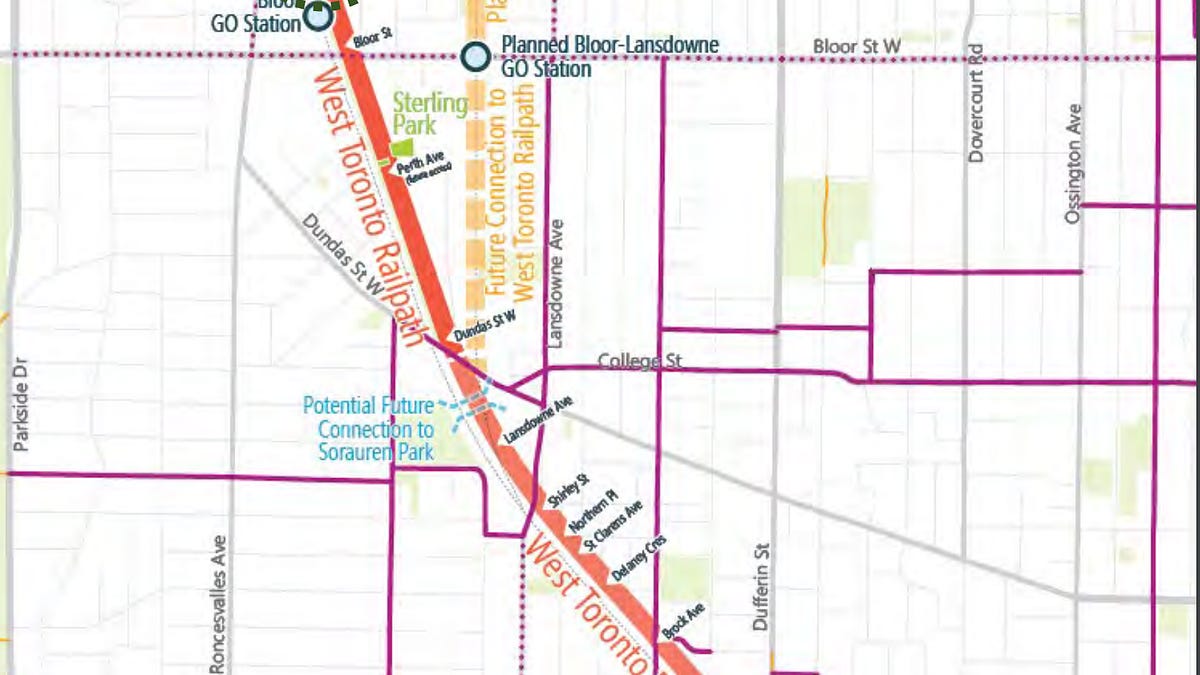
This project seems to be perpetually a year or two away from construction. Back in 2010, there was hope that the railpath extension could be open for the Pan Am games in 2015. In 2016, construction was supposed to start in 2017. In 2020, construction was supposed to start in 2021 or 2022. The city's page still says construction will start in 2023. Now they're saying 2025.
Even when construction gets started, Metrolinx wants to take three years to build it. It took all of three years to build the entire UP Express, including four stations, and a 3km elevated guideway. Yes, there are bridges that add some complexity, but still, three years for a fully designed and funded trail?
My fear is that after all this waiting, we'll get another delay while the cost escalation gets sorted out. We do need transparency on costs, but also I want to know more details on the construction timeline. The city should be asking Metrolinx what it would take to build it in two years instead of three.


Yes. Absolutely. But if we have $150 million to spend on cycling infrastructure shouldn’t we spend it where it will have the most impact. A few extra meters does not seem the most impactful spend. But don’t get me wrong, I want both the Railpath extension and protected lanes. I’d support tolling the DVP and Gardner to get it.Isn’t a completely separated bike path without any stop lights a safest solution for a cyclist?
All this sharp criticism is somewhat undercut by the fact that none of this is new information. The updated cost estimate was included in the 2024 budget that Bradford and other councillors debated in February. The budget notes for Transportation Services noted the 2024 capital plan update now included “Increased funding of $74.000 million to advance delivery of the West Toronto Rail Path Extension.”
This wasn’t buried deep in the budget details — it was highlighted as one of the major changes to existing project budgets on page 16.
Later in the budget notes, on page 31, the increase is attributed to “escalating costs of construction, Metrolinx Administrative Costs, and major utility relocations.”
 toronto.cityhallwatcher.com
From Matt Elliott:
Railing against the rail path, and City Hall's island airport debate prepares for takeoff
The Week at Toronto City Hall for the week of August 19 to 23, plus a look at headlines about the West Toronto Rail Path, the AMO Conference, the Island Airport & more
You can of course argue that, given the cost, the City should pursue alternatives to the Rail Path to connect cycling routes, but I’d point out that this kind of off-street cycling infrastructure, which won’t take up road space or remove lanes for other vehicles, is exactly the kind of thing critics of on-street bike lane infrastructure have been calling for. Any alternative plan would need to be built on-street and would come with other trade-offs. Pick your poison.
You can of course argue that, given the cost, the City should pursue alternatives to the Rail Path to connect cycling routes, but I’d point out that this kind of off-street cycling infrastructure, which won’t take up road space or remove lanes for other vehicles, is exactly the kind of thing critics of on-street bike lane infrastructure have been calling for. Any alternative plan would need to be built on-street and would come with other trade-offs. Pick your poison.
And the complaints all undersell how important and valuable this project really is ("a two-kilometre walking trail" (Matlow), "nice to have, ... not a need to have" (Bradford))Elliott makes another excellent point:
They don't actually want this kind of bike infrastructure off the road. Thats just what they say they want when trying to cancel the on-street infrastructure.
What they really want is nothing.