





Platinum107
Senior Member
You people have fair points, and I do respect your opinions, so I do apologize if I came off as hostile. I don't deny that it could lead to a better city in years to come, however it likely isn't better for most Edmontonians currently. Encouraging public transit is fine, and I support public transit (as for some, it's more convenient and economical).
But why do you need to specifically discourage cars? I think it's that even you realize that most people will choose a car if they could. It's more comfortable, private, quicker, and allows for people to deal with variability and multiple locations to transit to. If you really believe that discouraging cars for more to take public transit, you could very well be correct.
I will admit, I thought this might be feasible as I lived in Oliver previously, and have a spouse who worked downtown. However, moving away from the core, and purchasing a single family home away from the core, opened my eyes a lot away from the perspective of a yuppie, and how the majority of Edmontonians actually live (especially those with families). I've also worked in Europe where I didn't own a car, and had been a user of a fantastic public transit system. I realize I may be projecting my own situation here, but I guess I question if the people who really want to get rid of cars could possibly living in a bit of a bubble themselves, and could possibly have a limited perspective (which is why their beliefs may be popular on a forum like this, however not so popular in a broader public opinion).
Thanks for the response! I can come off a little forceful with my posts sometimes as well, so I get it.
I guess my thinking comes down to this: It's less about "discouraging/hating on cars" and more about having a more appropriate and functional balance of modes which people use to traverse an urban area. Of course walking, biking, rolling, and public transit don't work in every case and private vehicles (especially when travelling to and from a rural area and relating to commercial/industrial uses) are an important piece of the pie needed for a healthy city to function. However, 90% or more of the transit pie is made up of this one section and it's draining the wealth and social stability that has been built up in this city over hundreds of years, the effects of which are becoming more and more pronounced as time goes on.
I'll respond to your specific points:
I think it's that even you realize that most people will choose a car if they could. It's more comfortable, private, quicker, and allows for people to deal with variability and multiple locations to transit to. If you really believe that discouraging cars for more to take public transit, you could very well be correct.
I agree, and I do realize that the demand is very real for cars. However I'd argue that for the most part the demand doesn't stem from an actual true desire for a car, but rather more from knowing that you'd need to have one to do anything easily and quickly in the urban environment we've built. It's really more like a forced demand rather than an optional one, and that's what many of us here are advocating to change! Besides the private part, frequent quality transit mixed with a dense and walkable urban form could beat out cars on all those metrics, and I do believe that people would choose those options if it was made optimal to that point.
However, moving away from the core, and purchasing a single family home away from the core, opened my eyes a lot away from the perspective of a yuppie, and how the majority of Edmontonians actually live (especially those with families). I've also worked in Europe where I didn't own a car, and had been a user of a fantastic public transit system.
This is exactly the issue right here!! The majority of Edmontonians live in low-density pre-suburban or new suburban areas with Euclidian zoning and car-centrism, and that's really hurting the health and wellbeing of our city. I'm not putting the blame on the people here, rather on the post-war standard created by private companies and upheld by the government for so long, the results of which are cities built against the principles of what made them cultural-packed self-sustaining places of the past.
Your Europe point plays exactly into what I'm saying: Ask yourself, why didn't you have to own a car in that particular city? Why was the public transit fantastic? Because it was a city that used what it had to its advantage, being walkability and density!
Would you believe me if I told you that Edmonton used to be just as powerful and full of life as many European and Asian cities??
Look at these historic photos of Jasper Avenue:


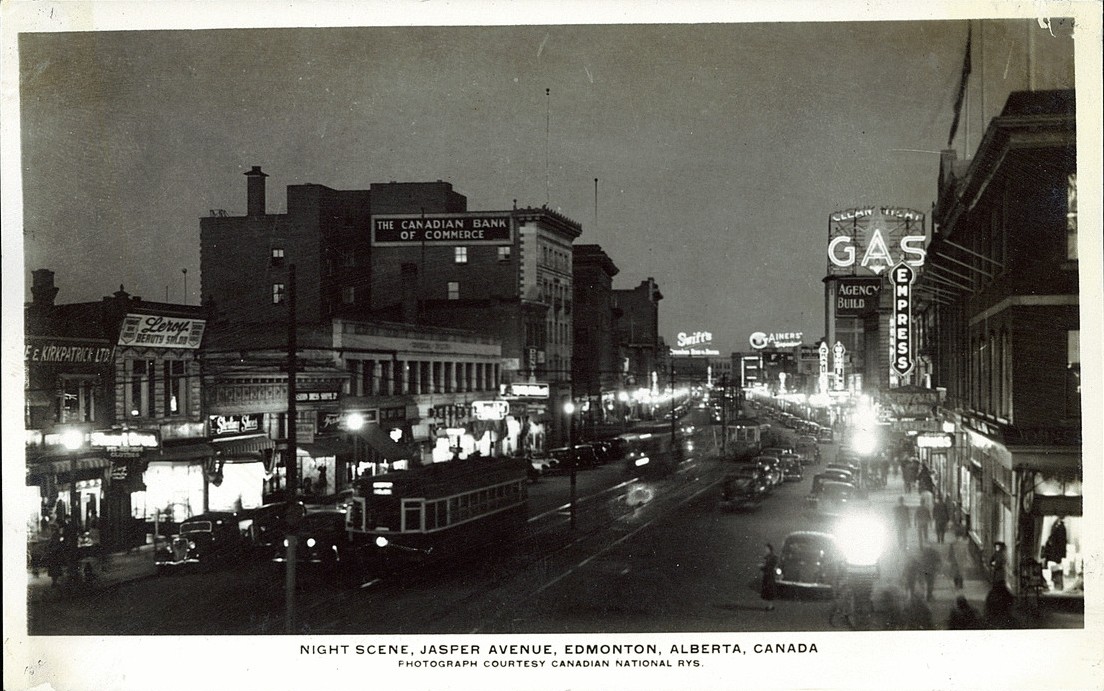
15 extraordinary photos of Edmonton's Jasper Avenue dating all the way back to 1907 - Livabl
See what was it like to walk down Edmonton's bustling Jasper Avenue in the first half of the 20th century.
www.livabl.com
^Although old, these pictures show a place fully come alive, full of activity, social and economic wealth, and just overall the true spice of what makes a city a city rather than a puzzle of uses.
Now look at Jasper ave today:

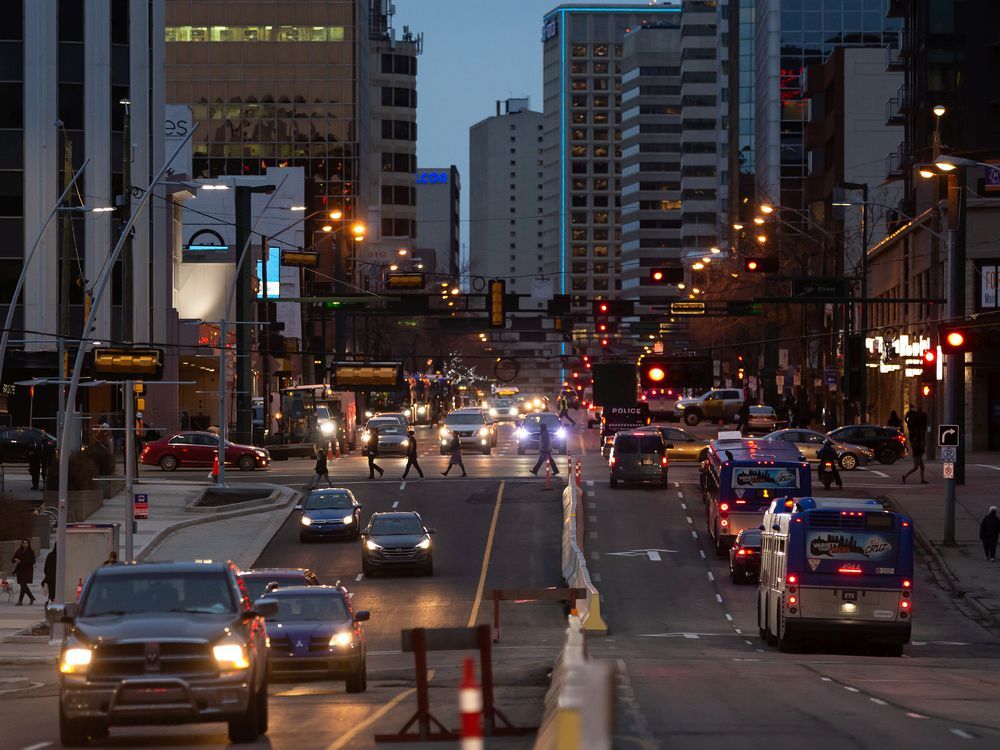
Speed limit on Edmonton's residential roads will drop to 40 km/h next summer
Speed limits on Edmonton’s residential roads and several high-pedestrian main streets will drop to 40 km/h next summer after a 9-3 vote by city council Wednesday af…
 edmontonjournal.com
I see a thoroughfare more than anything else, a space that people want to pass through or only be in for minutes at a time.
I realize I may be projecting my own situation here, but I guess I question if the people who really want to get rid of cars could possibly living in a bit of a bubble themselves, and could possibly have a limited perspective (which is why their beliefs may be popular on a forum like this, however not so popular in a broader public opinion).
I think living in bubbles is a problem that everyone faces, which is why it's great to have a healthy but effective discussion like this. One of my goals as of recent has been to really look at the other perspective on the issues of urbanism and get down to the arguments of why people may support urban sprawl and car-centrism, and you've really helped me today see that other side a little more, so thank you for that! To be honest, I want to share my ideas past this forum and have discussions with more people, but I'm still figuring out how I could do that sustainably.
Either way I believe that we all want to see things improve in Edmonton and in North America as a whole, and that we all have different solutions and ideas which each have a thread of truth in them. I just wanted to share mine today. Thanks for reading!
P.S. could @CplKlinger or @westcoastjos move these last few posts to the Suburban Sprawl thread or something related if possible? I think we've gotten a little too far off of Stantec Tower hahaha!


