Harry Sisson collated a lengthy series of Trump’s posts from a couple of weeks ago. This man is leading a country, and millions of people are apparently ok with that.

View attachment 736253

Yep. He did that the other night. He went from the usual one or two crazy Truth Social posts to like, 50 of them. He's certifiably insane and losing his damn mind.
 

FBI Created ‘Payback Squad’ to Handle Political Cases, Sources Say

Investigators are eyeing cases similar to the recent criminal prosecution of former FBI Director James Comey, one current government official told NOTUS.

The FBI now has a team of special agents that’s being internally referred to as the “payback squad” specifically put together to handle politically sensitive cases, according to four sources briefed on the matter who spoke to NOTUS on the condition of anonymity. The team is understood to be made up of agents who are willing to pursue political targets set by the Trump administration, with one current government official noting that investigators are tasked with building cases similar to the recent criminal prosecution of former FBI Director James Comey. The sources — which include two current government officials, a former official and a fourth person familiar with current operations — differed on whether the squad is based out of Washington headquarters or New York. A current law enforcement official described the squad as a team of agents who know what they’re signing up for and work temporary rotations at an off-site location away from standard FBI field offices as part of an effort that began roughly a year ago. Asked about the matter, a senior FBI official speaking on background denied that a new squad was created with that particular name. However, this person said bureau personnel are likely referring to an effort stemming from what is officially called the Director’s Advisory Team, a group that was created early last year as a “special investigative” unit tasked with “getting to the bottom of some abuses of power that happened” during the previous three presidential administrations. That relatively new investigative team was “detached” from the FBI’s Washington Field Office and has recently added new agents out of New York, the senior official said. This official said the Director’s Advisory Team is currently building a criminal case that seeks to charge former top government officials with a “grand conspiracy” against President Donald Trump. That particular investigation aims to indict former CIA Director John Brennan in the coming weeks, likely in South Florida, according to two other officials with knowledge of the matter. The Director’s Advisory Team includes former FBI agent John Eckenrode, who previously worked on the special counsel investigation led by the prosecutor John Durham that examined the origins of the FBI investigation into Russian interference in the 2016 U.S. election. According to a source with knowledge of the Brennan probe, Eckenrode and others on the Director’s Advisory Team in recent weeks have discussed the progress of the investigation with federal prosecutors in the U.S. Attorney’s Office for the Southern District of Florida and Joseph diGenova, the newly appointed Trump loyalist who was sworn in as a “special counselor to the attorney general” to lead the effort. The news about the so-called “payback squad” comes as FBI Director Kash Patel faced a grilling Tuesday from Democratic senators, who questioned his fitness to lead the bureau in light of recent stories in The Atlantic that claimed he “has alarmed colleagues with episodes of excessive drinking and unexplained absences.” Sen. Chris Van Hollen asked whether Patel has subsequently forced FBI staff to undergo polygraph lie-detector tests in an attempt to identify who has spoken to journalists, prompting Patel to attack him directly. Sen. Patty Murray cited “extremely troubling stories recently about your leadership and temperament” and asked him whether the FBI is investigating journalists. “I can tell you unequivocally, this FBI is targeting no journalists,” Patel responded.
 

Trump Taps Don Jr.’s 38-Year-Old Turkey-Hunting Pal to Lead FDA

Kyle Diamantas is a lawyer, not a doctor, who will oversee products making up a quarter of the U.S. economy

If you’ve ever swallowed an aspirin, put milk in your coffee, fed your pet, or filled a prescription, then you’ve relied on the lifesaving oversight of the U.S. Food and Drug Administration. Long viewed as the world’s gold standard in regulating food and medicine, the FDA is a behemoth that oversees products comprising roughly one quarter of the U.S. economy. Even on the best of days, the FDA commissioner — a Senate-confirmed position — must wander a pitiless wilderness of excruciating judgement calls, whether the record-speed approval of Covid-19 vaccines or the minefield of mail-order birth control pills, all while fending off powerful companies expecting VIP treatment. Doing the job well, or even at all, is not a friend-building exercise. After days of being dangled like a cat toy between warring parties in the White House and the Department of Health and Human Services, which oversees FDA, news broke on Tuesday that President Donald Trump’s embattled FDA commissioner, Dr. Marty Makary, a Johns Hopkins surgeon, was resigning. Attention immediately turned to the question of which towering medical figure might step into the job. Soon after Trump posted Makary’s resignation text to Truth Social, Kyle Diamantas, 38, an obscure Florida lawyer who first landed at the FDA in 2025 as director of the human foods program, following his previous role as Don Jr.’s hunting buddy, was named acting FDA commissioner. In March 2021, Don Jr. and Diamantas posed holding dead Osceola wild turkeys, as I had first reported. Mike Tussey, the founder of the hunting outfit Osceola Outdoors, described the scene on X as: “Don Jr. With his good friend Kyle Diamantas! Kyle’s first Osceola!” A picture of Trump Jr., Diamantas, and Tussey, with a single turkey, is featured on Osceola Outdoors’s website. How you get from hunting turkeys with the president’s son, to overseeing 1,000 employees in the FDA’s human foods program, to serving as acting FDA commissioner is a story whose outlines have become familiar throughout Trump’s second administration, where being buddies with the right people is a qualification in and of itself. It is perhaps testament to the current state of the FDA that Diamantas was the only deputy commissioner who could credibly assume the role, says Susan Mayne, professor adjunct at Yale School of Public Health, who served as the FDA’s director of food safety and applied nutrition from 2015 to 2023. “Mr. Diamantas is not an MD. It’s an unusual choice. But given the circumstances, it’s the logical choice.” After DOGE staff cuts devastated the agency, and ongoing turmoil has led scientists to leave in droves, the FDA organizational chart has been denuded of leadership. And in an FDA wracked by diva-style personnel eruptions, Diamantas had a “more balanced style of leadership,” says Mayne. In what should have been a sober regulatory environment, under Makary’s stewardship, chaos was often the headline. There was the director of the Center for Drug Evaluation and Research, George Tidmarsh, who was forced to resign, after allegedly using his regulatory role inside the agency to pursue a vendetta against a former business partner. And there was Vinay Prasad, who served as director of the FDA’s Center for Biologics Evaluation and Research, who roiled the pharmaceutical industry — and his own staff — with an abrasive leadership style and peremptory rejection of certain drug applications. Amid innumerable battles, it was ultimately a fight over fruit-flavored vapes that ended Makary’s tenure, after Trump had a “fateful lunch” with tobacco industry executives seeking approval for their products, an FDA official says. The White House was exerting pressure on the FDA to approve the products and Makary was resistant, given that such products would clearly appeal to kids. “It was the end of the rope for him,” says a Makary associate. “He didn’t want to sign off on candy flavors.” But ultimately he did sign off, albeit too late to save his position. Trump thanked him on Tuesday in a social media post, writing, “He was a hard worker, who was respected by all, and will go on to have an outstanding career in Medicine.” Diamantas has the job on a temporary basis for now, and anyone tapped to fill it permanently would need to sit for Senate confirmation hearings. One name that has emerged as a possible candidate is Admiral Brett Giroir, a pediatrician who served as the assistant secretary for health at HHS during the first Trump administration, and oversaw diagnostic testing during the Covid pandemic. Giroir, reached by Rolling Stone on Tuesday, declined to comment. It’s unclear if or when Trump will nominate someone, though, and there’s no telling how long Diamantas could wind up overseeing the FDA on an acting basis.
 

Trump administration calls transgender people national security threat​

The Trump administration has labeled transgender people a national security threat on par with drug cartels and Islamic militant groups.
A new “counterterrorism strategy” published by the White House states: “Our national (counter terrorism) activities will also prioritize the rapid identification and neutralization of violent secular political groups whose ideology is anti-American, radically pro-transgender, and anarchist. We will use all the tools constitutionally available to us to map them at home, identify their membership, map their ties to international organizations like Antifa, and use law enforcement tools to cripple them operationally before they can maim or kill the innocent.”
The document also links the alleged murderer of Charlie Kirk to “extreme transgender ideologies.” It says: “This administration will continue to prohibit the (intelligence community) from being used politically against innocent Americans. As real threats were ignored or underplayed, Americans have witnessed the politically motivated killings of Christians and conservatives committed by violent left-wing extremists, including the assassination of Charlie Kirk by a radical who espoused extreme transgender ideologies.” According to PBS News, Tyler Robinson “was involved in a romantic relationship with his roommate, who investigators say is transgender.” However, there is no public concrete evidence his roommate’s gender identity motivated Robinson to allegedly shoot Kirk. Nevertheless, Trump and his evangelical base have made sweeping claims linking Kirk’s murder to “extreme transgender ideologies.” The Trans Journalists Association has published an entire website page to debunking the claims of Trump and his new counter terrorism strategy. That resource explains: “’Transgender ideology’ remains a term coined for and used in anti-trans political messaging to falsely equate identity with politics, which is a way to frame transgender identity as a political choice rather than an innate identity. The phrase itself is unclear — similar to how ‘the homosexual agenda’ is an amorphous term with no real definition — and used exclusively to attack a minority group for political gain.” The TJA says this anti-trans language is “rooted in Project 2025’s goal of narrowing interpretations of gender, sexuality and race in federal policy and rolling back the rights of diverse communities.” This group documents that in the first 16 months of the second Trump administration, Trump has brought about health care restrictions for transgender youth and adults; reversals to policies that protected trans people from discrimination; the erasure of LGBTQ-inclusive data collections and ongoing challenges to trans people having access to public spaces. Trump earlier falsely claimed there had been an “incredible rise” in the number of transgender shooters. “This was untrue then, and it remains untrue now,” TJA noted. “Anti-trans actors have persistently [and] falsely claimed that mass shooters are disproportionately transgender or that transgender people are more likely to commit crimes. These claims now reliably resurface online when shootings occur.” Meanwhile, an international advocacy group has warned the Trump administration is plotting genocide against transgender people. The Lemkin Institute for Genocide Prevention and Human Security issued a “Red Flag Alert” for the United States based on the Trump administration’s anti-trans initiatives. “The Republican Party’s anti-trans agenda has radicalized and continued to intensify,” the warning states. “2025 was the sixth consecutive record-breaking year for the number of anti-trans bills considered across the country. There was a 45% increase in bills between 2024 and 2025. Between 2021 and 2025, the number of bills in consideration has increased by 668%. “The administration has moved from identifying transgender people as a threat to the family and to the nation’s military prowess to claiming that transgender people constitute a cosmic threat to the spiritual health of the nation and the greatest direct threat to U.S. national security in the world. Given these ideological developments, especially coupled with the increasingly hostile and draconian legislation against trans identities, the Lemkin Institute believes that the United States is squarely within the early to middle stages of a genocidal process against trans people, the goal of which is to completely erase transgender people not only from public life but also from existence in the U.S. and globally.”
 
  • Kelly Ortberg, president and chief executive of Boeing
  • Ryan McInerney, chief executive of Visa
  • Brian Sikes, chief executive and chairman of Cargill
  • Jim Anderson, chief executive of Coherent
  • Henry Lawrence Culp, chief executive of GE Aerospace
  • Jacob Thaysen, chief executive of Illumina
  • Michael Miebach, president of Mastercard
The companies all have some sort of product or service that can be sold to the Chinese market. They want money.

Cargill sells food and grain.

Coherent sells optical transceivers for data centres, lasers, other optical stuff, semiconductor adjacent products.

Illumina is in biotech, DNA sequencing etc.

Visa and Mastercard were finally allowed in QR code mobile wallets in 2023. Some Chinese transit systems even accept Visa and Mastercard tap now (like Presto). They're probably pushing for more market access.

Boeing and GE Aerospace: domestic production doesn't come close to meeting demand. Air industry numbers show roughly 10 to 20% higher trip/aircraft movements/airport traffic compared to 2019.

The broader economic recovery may be weak, but the airlines are starving for new planes and engines in China.
 
Remember that Donald Trump blockaded Cuba energy supply to get them to "surrender" to him?

As the U.S. starves it of oil, Cuba is pulling off one of the fastest solar revolutions on the planet — with China’s help​

From https://www.ctvnews.ca/world/article/as-the-us-starves-it-of-oil-cuba-is-pulling-off-one-of-the-fastest-solar-revolutions-on-the-planet-with-chinas-help/?taid=6a046a23e5e843000126e252

1778696069202.png

In this July 17, 2013 photo, workers are framed by solar panels at Cuba's first solar farm in Cantara. (AP Photo/Franklin Reyes)

Cuba is struggling with devastating nationwide blackouts as the United States’ effective oil blockade strangles fuel supplies. But this crisis may also be accelerating a China-backed clean energy revolution that’s been quietly unfolding in the Caribbean nation.

Cuba is currently pulling off one of the fastest solar revolutions on the planet, with help from China, according to data from the energy think tank Ember. Imports of Chinese solar panels and batteries have soared over the past year and, with Chinese investment, Cuba has built dozens of solar parks.

The country is still heavily dependent on fossil fuels, but some experts believe the intense U.S. pressure — with threats to take “control” of the island — may hasten Cuba’s path toward clean energy. More renewables mean less dependence on fuel imports, helping “remove this lever of coercion,” said Kevin Cashman, an economist with the Transition Security Project, a U.S.-U.K. research organization.

Others caution that Cuba’s energy situation is so bleak, its grid so broken and its economic situation so dire, that renewables can only be a small part of the puzzle right now. In the meantime, lengthy and disruptive blackouts continue and most ordinary Cubans have yet to feel the benefit of the solar surge.

A clean energy revolution “sounds nice on paper, but you’ve got to have the resources,” said Ricardo Torres, a Cuban economist at the American University in Washington DC.

Oil is the backbone of Cuba’s electricity system and most of it is imported. In the 1980s, it came mainly from the Soviet Union. When that fell in the 1990s, Cuba switched to Venezuela, with a unique agreement where Cuba sent medical professionals to Venezuela in exchange for oil.

In early January, after the Trump administration captured Venezuela’s president, it cut off this oil supply. Shortly after, imports to Cuba from other oil suppliers, including Mexico, also dried up after the US threatened them with additional tariffs.

The impacts have been devastating. In March, the country experienced three nationwide blackouts, cutting electricity for its roughly 10 million residents. Trash piled up in the streets, hospital surgeries were limited and people burned wood to cook.

It is Cuba’s worst energy crisis in decades, but blackouts have been part of daily life for many years, as the country’s aging electricity infrastructure frequently buckles under the weight of a demand it cannot meet.

The crisis reached new levels in 2024, with multiday nationwide blackouts. It marked a “turning point,” Torres said, and was the year solar started to take off, promoted by the Cuban government as a solution to energy problems.

The speed of the solar surge has been startling. China exported around US$3 million of solar panels to Cuba in 2023; that figure rocketed to $117 million in 2025, according to Ember.

A big part of the country’s clean energy push is an agreement with China to open 92 solar parks across the country by 2028, projected to bring a total of 2 gigawatts of solar power online, enough to power more than 1.5 million homes.

Cuban President Miguel Diaz-Canel opened the first in February 2025 and there are now around 50 online, dotted across the island. Cuba has installed around 1 gigawatt of solar in the last 12 months alone, Graham said, “that does actually make a pretty meaningful dent in the in the power mix of a country the size of Cuba.”

Renewable energy now makes up roughly 10% of Cuba’s electricity, up from around 3% in 2024. “It’s a really, really rapid boom,” Graham said. The country has pledged that figure will rise to at least 24% by 2030.

The benefits of solar for Cuba are clear. Costs of clean technology have plummeted in recent years and solar is relatively fast to install, Graham said. The infrastructure lasts decades and, once set up, needs only sunshine.

There’s a benefit for China, too, which goes beyond financial, said Jorge Piñon, a senior research collaborator at the University of Texas’s Energy Institute. It will “build goodwill, not only goodwill within Cuba but goodwill with the rest of Latin America,” Piñon said.

Experts warn there are big hurdles to a broader solar revolution, however.

The surge may be rapid but solar power is not yet available at scale. Cuba’s solar parks are small and scattered, Piñon said. Solar power is also only generated when the sun shines, meaning it cannot meet peak evening demand. Batteries can solve this, and battery imports have soared, but Cuba still lacks utility scale storage, Piñon said.

Perhaps the biggest issue, however, is cost. A solar revolution won’t come cheap. “You’re talking about a major overhaul of a system that is old, is broken, is tired,” Piñon said.

It would cost $8 billion for Cuba to generate around 93% of its electricity from renewables, meaning it would no longer need to import oil and gas for electricity, according to an April analysis by Cashman. A 100% renewable electricity system would cost $19 billion. “The first threshold breaks the main external lever of US coercion; the second completes the electricity transition,” the report concluded.

The billion-dollar question is who pays for it. “You have the state that’s broke, doesn’t have any money. You have the Cuban consumer that can’t afford it. So who’s left?” Piñon asked.

Cashman’s report suggests development finance institutions will be key. But Cuba would need to show it could pay back loans and this will take time, Piñon said, “which Cuba does not have.”

There are limits to China’s support, too. It’s unlikely to offer Cuba a “blank check,” Torres said. Energy independence would be great, he added, but Cuba “is a poor country in the middle of an economic crisis.”

For some Cubans the solar surge is already yielding benefits. At the country’s first solar-powered charging station in the city of Santa Clara, Cubans can charge anything from cellphones and power banks to electric motorbikes.

“They have solved many problems for many people,” said Yudelaimys Barrero Muñoz, in an interview with the Associated Press. She uses the station to charge her family’s electric three-wheeler.

Yet for most, the advantages are not yet visible, Torres said. He has bought small solar modules for family in Cuba, but solar is out of reach for the majority who struggle even to afford food.

If you ask the average Cuban if they have seen any benefit of the solar program in their daily lives, Torres said, “the likely answer is going to be no … Because the blackouts are now worse than they were a year ago.”

He believes renewable energy must play a role in the country’s electricity mix. But what Cuba needs isn’t just cleaner electricity, but more of it and fast, he said. People need guaranteed supply and it doesn’t matter to them whether it comes from the heaviest, most polluting oil or from solar, he added.

Others, however, see a more positive road ahead for the rapid deployment of renewables not only in Cuba, but also elsewhere, as the costs of clean tech continue to fall and geopolitical turbulence lays bare the perils of relying on fossil fuel imports.

“No matter what happens to Cuba,” Cashman said, “this is a clear signal to other countries that renewables are something that they need to focus on.”
Then there are the wind turbines being erected in Cuba.
 
Remember that Donald Trump blockaded Cuba energy supply to get them to "surrender" to him?

As the U.S. starves it of oil, Cuba is pulling off one of the fastest solar revolutions on the planet — with China’s help​

From https://www.ctvnews.ca/world/article/as-the-us-starves-it-of-oil-cuba-is-pulling-off-one-of-the-fastest-solar-revolutions-on-the-planet-with-chinas-help/?taid=6a046a23e5e843000126e252

View attachment 736318
In this July 17, 2013 photo, workers are framed by solar panels at Cuba's first solar farm in Cantara. (AP Photo/Franklin Reyes)


Then there are the wind turbines being erected in Cuba.
Wonder how well these will weather hurricanes...
 
Remember that Donald Trump blockaded Cuba energy supply to get them to "surrender" to him?

As the U.S. starves it of oil, Cuba is pulling off one of the fastest solar revolutions on the planet — with China’s help​

From https://www.ctvnews.ca/world/article/as-the-us-starves-it-of-oil-cuba-is-pulling-off-one-of-the-fastest-solar-revolutions-on-the-planet-with-chinas-help/?taid=6a046a23e5e843000126e252

View attachment 736318
In this July 17, 2013 photo, workers are framed by solar panels at Cuba's first solar farm in Cantara. (AP Photo/Franklin Reyes)


Then there are the wind turbines being erected in Cuba.
All he has to do is send in a platoon of marines to topple Cuba.
 
Wonder how well these will weather hurricanes...
This is really giving that whole "...but at what cost?" dialogue China always gets when it does something relatively good. Supply Cuba with solar panels so they don't get crippled by US sanctions? At what cost?

If they're able to "flood the world" with their product they will simply resupply Cuba with any that are damaged in storms. It's not a negative thing that we suddenly have an abundance of cheap, available solar panels.
 
Wonder how well these will weather hurricanes...
See https://solartechonline.com/blog/solar-panels-hurricanes-complete-guide/

Key Insights​

  • Solar panels demonstrate exceptional hurricane resilience: Real-world data shows less than 0.1% of properly installed solar systems experience significant damage during major hurricanes, with many installations surviving Category 5 storms with minimal issues.
  • Solar + battery systems provide superior storm preparedness: Homes equipped with solar panels and battery storage maintain power for essential needs during extended grid outages, with some systems providing 11+ days of electricity independence during hurricane recovery periods.
  • Advanced engineering exceeds building requirements: Modern solar panels are tested to withstand 140-160+ mph winds and 2-inch hail impacts, often exceeding local building code requirements and outperforming traditional power infrastructure during extreme weather events.
  • Proper installation is critical for hurricane performance: Success depends on certified installers using hurricane-rated mounting systems with direct rafter connections, appropriate for local wind zone classifications and building codes in storm-prone regions.
Guess depends upon how they were installed. If built by a Donald Trump company, probably would not survive.
 
All he has to do is send in a platoon of marines to topple Cuba.
A platoon of Marines typically consists of 43 Marines, including a platoon commander and several rifle squads. The size can vary, but it generally ranges from 20 to 50 troops.

The Bay of Pigs invasion was a failed military operation that took place from April 17 to April 20, 1961, where approximately 1,500 Cuban exiles, backed by the U.S. government, attempted to overthrow Fidel Castro's regime in Cuba. The invasion ended in defeat for the exiles, strengthening Castro's position and leading to increased ties between Cuba and the Soviet Union.
 

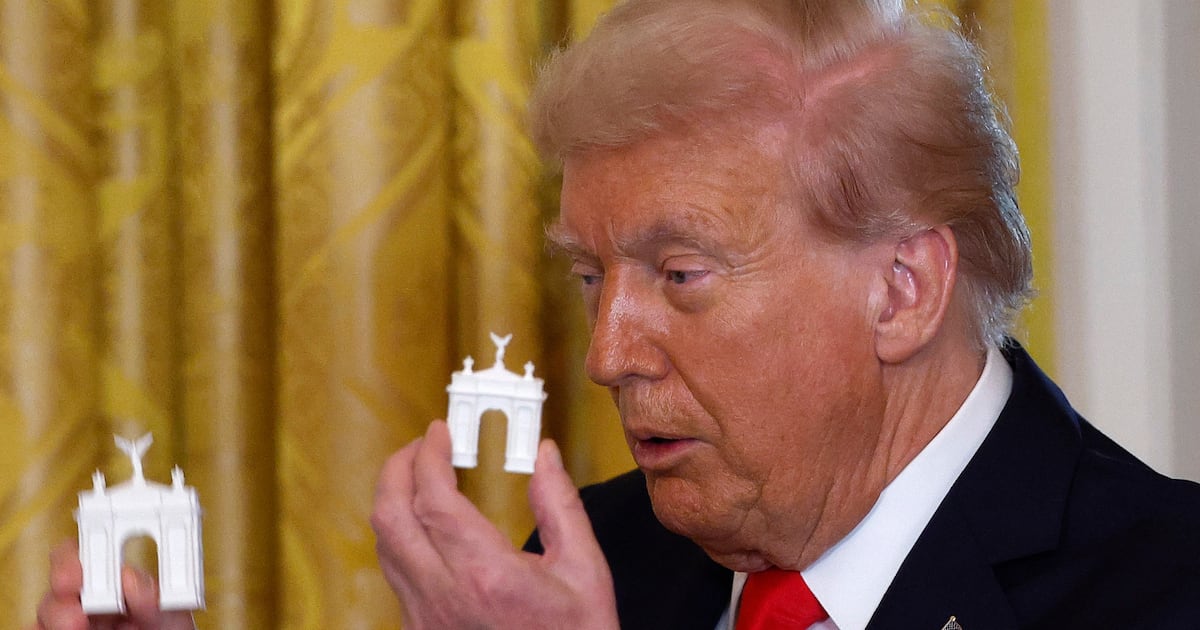
Trump Team’s Secret Shortcut Plot for His Vanity Project Leaks​

The president wants his “triumphant arch” come hell or high water and one aide is trying her hardest to find a loophole.

President Donald Trump’s officials appear to have quietly schemed to break ground on his coveted D.C. “triumphal arch” by tacking the job onto an unrelated engineering project.
Messages obtained by the Washington Post shed light on the April correspondence between National Park Service acting director Jessica Bowron and the president’s team.

Bowron asked whether a deal already held with engineering giant AECOM for work on White House grounds could be stretched to cover a survey of the nearly 280-foot monument’s future home.
The plot set aside for the arch sits over a mile from the White House. Bowron herself acknowledged that fact in her email, but said that extending the existing contract would allow work on the arch to “align with the administration’s timeline.”
Trump has demanded that work begin on the structure to coincide with America’s 250th birthday later in July.
Tacking the project onto AECOM’s prior contract would potentially allow the administration to bypass a lengthy bidding process for the assessment.
It would also preclude any other companies from competing for the chance.
The Department of the Interior, of which the National Park Service is a part, insists the Post’s “assertion on contract sourcing is incorrect” and has brushed off the leaked exchange as “draft/deliberative conversations.”
An anonymous official nevertheless told WaPo that the agency would likely lean on “existing contracts for the environmental assessment process” given that “it is in the best interest of the government, more convenient and economical.”
Watchdogs aren’t sold. Stan Soloway, a former Pentagon procurement chief, called any tie between existing engineering projects at the White House and the arch grounds “a real stretch.”
Government-contracts attorney Alan Chvotkin added that taxpayers would “lose the benefits of competition, pricing and transparency.”
The Daily Beast has contacted the White House and National Parks Service for comment on this story.
The status of any conversations about the proposed shortcut remains an open question following reports on Wednesday that the Federal Aviation Administration is now probing safety concerns over the arch. Those concerns stem from the proposed monument’s proximity to Ronald Reagan Washington National Airport.
The airport handles 900 flights a day and has witnessed a number of high-profile collisions over the years, including a crash between a commercial jet and a military helicopter that killed 67 people last January. FAA regulations state any structure over 200 feet that could potentially interfere with air traffic should be subject to review prior to construction. That process is supposed to take a maximum of 90 days, but it often stretches beyond nine months.
 

Back
Top