





nfitz
Superstar
I don't know the answer, but a 80 km/hr curve is a 50 mph curve, and railway design is normally done in miles.Question: are they 80km/h curves or 50km/h curves?
So I'd guess just a minor typo, and they are 80 km/hr (50 mph) curves.
|
|
|
I don't know the answer, but a 80 km/hr curve is a 50 mph curve, and railway design is normally done in miles.Question: are they 80km/h curves or 50km/h curves?

Question: are they 80km/h curves or 50km/h curves?
I somehow think the presentation slides weren't proofread as there seem to be a lot of inconsistencies between the slides and the report. Regardless of what the speed of those curves are, I do like the idea of bypassing Acton and Rockway due to the complications of being able to widen the existing curves and grade separate the line.
I still think it makes the most sense to run the HSR track through the middle of Guelph rather than bypass it, even with the property acquisition and grade separation that would be required. In my mind, it makes more sense to electrify, grade separate, and provide maintenance for one rail line instead of two.
In isolation, it may make more sense to bypass Guelph completely, however with all-day RER service on the line and the number of trains that would be on the line, the 5 km/h slow order at Kent St will need to be resolved one way or another, grade separation being the most likely.
^ I really hope they don't relocate Acton GO station. I also wonder if there are any plans to add a Rockwood station eventually.
A direct Pearson-Kingston route is completely unthinkable! Pearson apparently has 49 departures to Kingston per week, mostly on Beechcrafts. Even assuming 100% capacity that's less than 1000 passengers/week, or less than a single HSR train. It's also assuming that a notional Toronto-Ottawa HSR wouldn't be better off just skipping Kingston in the first place and shaving 50km off the route (significant cost savings)..
The existing slow zone along Kent street in Guelph is 10 mph (16 km/h). Grade separation would be necessary if we want to operate above 80 mph along that strech, but I think that's unnecessary given that most trains will stop at Guelph Central. In my opinion, the station is significant enough that it should be of Intercity status, meaning that all trains would stop there.


The existing slow zone along Kent street in Guelph is 10 mph (16 km/h). Grade separation would be necessary if we want to operate above 80 mph along that strech, but I think that's unnecessary given that most trains will stop at Guelph Central. In my opinion, the station is significant enough that it should be of Intercity status, meaning that all trains would stop there.
In Utrecht, The Netherlands I was staying off a street that had a similar arrangement. But trains were able to operate at a reasonable speed (I'd guess around 60-80 km/h) because the segment was fenced, blocking off some former pedestrian crossings. To cross the railway you had to go to a proper level crossing on a collector or arterial road.
So I'm guessing if we simply fenced the railway, blocking off the Glasgow and Dublin crossings, we could get the speed up to 45 mph or so.
The grade separation has less to do with the line's speed and the disruption caused by the frequency of the line. There could easily 6 trains per direction per hour on this stretch of track that would cause a lot of noise and vibration and delays. The rail corridor on Kent Street is also very narrow and can barely fit the two tracks (one disused) that are currently on it. The section of track would benefit from being placed in a trench to not only mitigate local impact, but to also duck under the low-speed switches at the junction with the Galt spur. The line itself would also benefit from a wider sweeping curve if properties on the south side of Kent St are acquired
I envision three classes of service on the line: Express, Intercity, and Local. While intercity and local trains would almost certainly serve Gulelph station, I would hope that express services blow through the station without stopping, and be able to maintain a reasonable (100km/h) speed while doing so.
If we had two major centres which were being linked, then I would see the justification for an almost non-stop high-speed service. But as of yet I've not heard any talk of connecting to Detroit or Chicago. As it stands, we're connecting one major centre with a couple medium-sized centres, skipping two slightly smaller medium-sized centres along the way. I expect that more people will be travelling between Kitchener and Guelph than between Kitchener and Toronto, so I don't think it makes sense to have twice as many trains serving the latter. The difference between Brampton and Guelph is that people from Brampton are mostly travelling within the GTA, where they are served by the intra-GTA local service as well as the regional service that would likely be the only all-day service serving Guelph.

In some countries, express trains are more express than that.
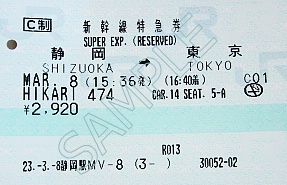
In Japan, the Shinkansen is "Super Express" in their English translation, printed on tickets to date.
Depends on how integrated their intercity systems are with their metro/regional train systems, and express intercity trains skips a few cities along the route. If we went by Japan/Euro standards, a true intercity express HSR will NOT stop at Guelph, will NOT stop at Oshawa, it's simply Kitchener-nonstop-Toronto-nonstop-Kingston-nonstop-Ottawa. Heck, forget Kitchener -- the super express whooshes past Kitchener-sized cities enroute between major metros. Even the Beijing-Shanghai express is far more express than that -- it runs nonstop for hundreds of kilometers before stopping.
I guess it depends on whether "express" is used in the context of intercity or local trains, and what the populace is used to.
Realistically we'll have a mix of HSR trains, and when we use the word "express" on a HSR, that's exactly it: It's not stopping at Guelph distances from Kitchener, by Japanese/Euro standards, no matter what you argue. Sure, their semi-express or non-express may, but what they call "express" will go nonstop for a hundred kilometers or more. The train schedule is a mix of express intercity and non-express intercity trains. Heck, Pearson is possibly a waste of a stop in a true HSR situation.
Given a four-track corridor plus a few station passing tracks, we may be able to sustain:
HSR Downtown Express: London-Kitchener-Union (2 per hour, plus extra trains during peak, 300kph)
HSR Express: London-Kitchener-Pearson-Union (2 per hour, 300kph)
HSR All Stops: London-Kitchener-Guelph-Brampton-Pearson-Union (2 per hour, 250kph)
GO RER Kitchener: All GOTrain stations (4 per hour, 160-200kph)
Figures -- we're Toronto, where Union-Pearson express has 3 stops.